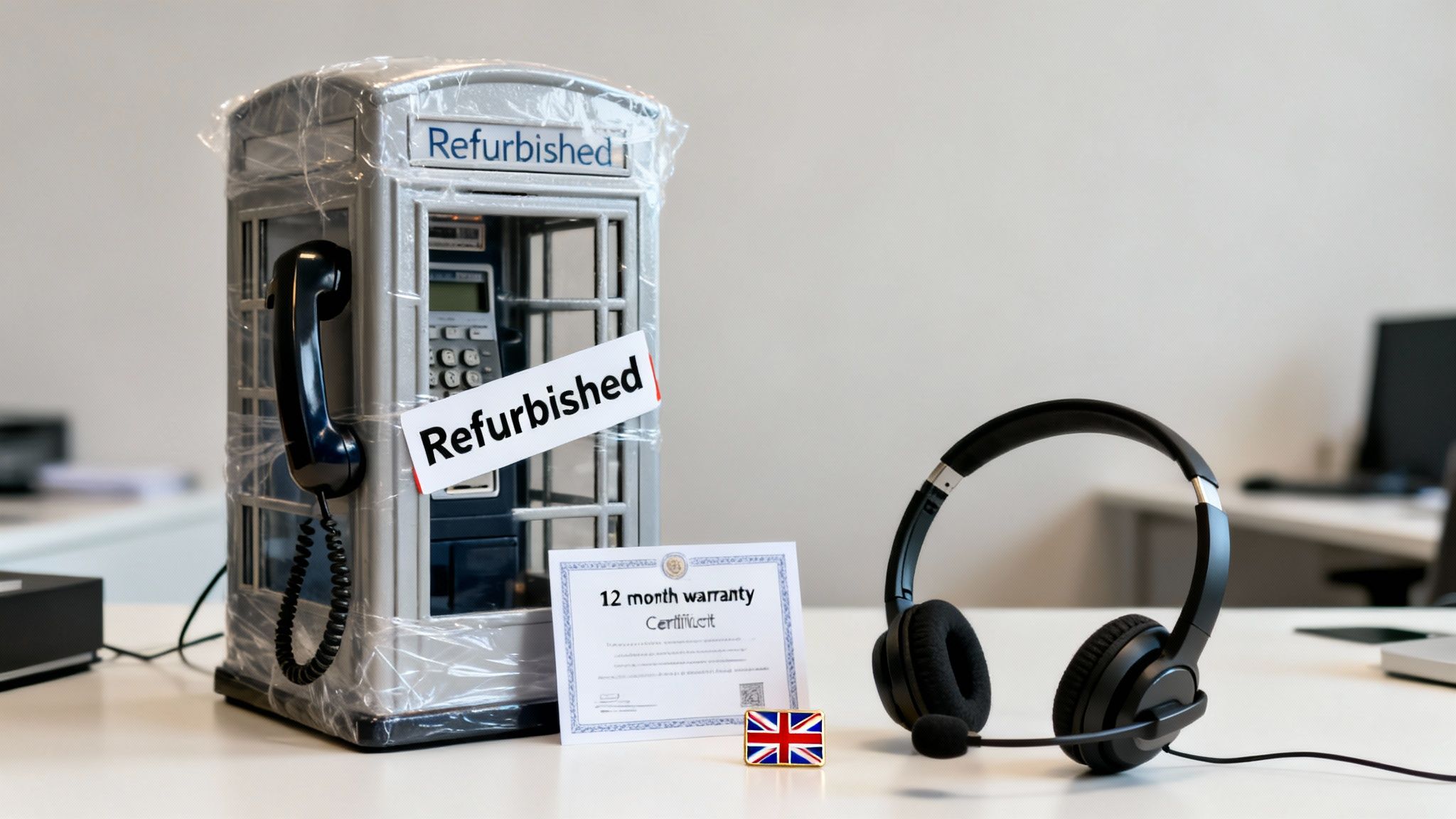
Meta description: Find the best refurbished iPhones under £200 in the UK for 2026, what to check before you buy, and where to shop safely for real value.
A new iPhone can feel like a small holiday you didn’t book, the price stings for months. The good news is refurbished iPhones under £200 can still cover the everyday stuff brilliantly, calls, WhatsApp, banking apps, photos, and Apple Pay.
The trick is choosing models that won’t feel slow by summer, and sellers that won’t disappear when something goes wrong. This guide keeps it simple, which models make sense in 2026, what to avoid, and where to find iPhones for sale without taking a punt on mystery “second-hand iPhones.
If you want peace of mind and a sensible price, start with a certified seller such as Used Mobiles 4U and treat the listing like a car advert. You’re looking for service history (testing), not shiny paint (marketing).
How to buy refurbished iPhones under £200 without getting caught out
At this budget, you’re shopping in the “great value, but choose carefully” aisle. Some used iPhones are bargains, others are tired batteries in a fresh box. So, focus on the three things that change your day-to-day use most: battery, returns, and network status.
First, take battery health seriously. Many reputable UK refurbishers set a minimum, often 80 percent or higher. Used Mobiles 4U states devices are fully tested and include at least 85 percent battery health, which matters more than a tiny scratch on the frame.
Next, read the grading like you’d read a hotel review. “Fair” usually means visible wear, while “Excellent” tends to look much cleaner. The phone should still be fully functional in all grades, but you don’t want nasty surprises on a screen you stare at for hours.
Also, only buy unlocked (SIM-free) unless you’re sure about the network. A locked handset can turn into a drawer phone when you switch providers.
Here’s the quick “before you pay” scan that saves the most hassle:
Battery promise: Look for a stated minimum battery health, or a clear replacement policy.
Warranty and returns: Aim for a 12-month warranty and at least 14 days to return.
iCloud and security checks: The seller should confirm the device is wiped and not Activation Locked.
Condition notes: If the screen condition isn’t described, assume the worst and move on.
If a listing avoids details (battery, grade, warranty), treat it like a car with no MOT history. The price might look sweet, but the risk isn’t.
The best refurbished iPhones under £200 (UK picks that still feel usable)
“Best” depends on how you use your phone. A teen scrolling socials needs a bigger screen, while someone who mainly calls and messages might prefer a smaller model with a home button.
The models below are the ones that most often make sense under £200 in February 2026, because parts are available, repairs are common, and performance is still acceptable for everyday apps.
A quick comparison helps you spot the right fit:
Model
Best for
What you’ll like
Watch-outs
iPhone SE (2022) (when discounted)
Fast basics in a small body
Strong performance for the money, 5G, familiar home button
Small screen, battery can feel tight for heavy use
iPhone 11 (sometimes under £200)
All-round daily phone
Good camera balance, easy to live with, big enough screen
No 5G, check condition carefully at this price
iPhone XR (often under £200)
Big screen on a budget
Comfortable display size, simple and reliable
Older camera tech, avoid low battery health
iPhone 8 / 8 Plus
Cheapest “proper iPhone” feel
Home button, solid build, wireless charging on iPhone 8
Older iOS support ceiling, smaller storage at low prices
iPhone 7 / 7 Plus
Lowest-cost iPhone that still works
Very affordable, fine for calls, messages, light apps
Older hardware, don’t expect long-term support
The sweet spot for many buyers is iPhone XR or iPhone 11, if you can find a clean grade with a healthy battery. They feel less cramped than the older 4.7-inch models, which helps if you read emails or use maps a lot.
On the other hand, iPhone 8 and iPhone 7 can be perfect “get it done” phones. Think of them like a dependable kettle, not a fancy coffee machine. They boil water every time, even if they don’t have every new feature.
If you’re torn between Apple and Android, be honest about what you need. Some Cheap Android Phones offer newer specs for the money, and a used Samsung Galaxy can be a strong choice under £200. Still, many people stick with iPhone because iOS feels familiar, resale value tends to hold, and accessories are easy to find.
For extra context on the wider market and what deals are around this month, Tech Advisor keeps an updated roundup of refurbished phone deals in the UK.
Where to buy cheap iPhones in the UK, and how to save even more
A good refurb isn’t just about the phone, it’s about what happens after delivery. That’s why buying from a UK seller with clear support matters. With Used Mobiles 4U, for example, you’re buying from a UK-based retailer offering a 12-month warranty, 30-day returns, free UK delivery, and transparent grading, which takes the edge off buying used iPhones online. You can browse their dedicated refurbished iPhones collection when you want to stay under budget.
You can also look at networks for “like-new” refurb stock. O2 has a public range of refurbished handsets under its Like New programme, with plan options and longer warranty terms on some tariffs, see O2 refurbished phones (Like New).
Now, the easy way to make £200 go further is to offset the cost with your old handset. If you’re planning to sell your tech, do it before your current phone becomes a cracked spare. Even older models can reduce the cost of your next device, especially if you trade-in my old phone while it still holds charge.
To keep it simple, aim for one of these routes:
Trade-in iPhone with a retailer credit if you’re buying immediately.
Sell old iPhone for cash if you want the lowest upfront price.
If it’s truly past it, recycle my old iPhone responsibly rather than leaving it in a drawer.
Before you hand it over, back up your data, sign out of iCloud, and disable Find My. Otherwise, the next owner can’t activate it, and you’ll be stuck sorting returns. A reputable refurbisher will guide you, but it’s faster if you do it yourself.
For a consumer-style look at what’s worth buying and typical deal patterns, The Independent regularly updates its guide to refurbished iPhone deals.
One last money-saver: if you can live with a few marks, choose a lower cosmetic grade and put the savings into more storage or a fresher battery.
Final thoughts and FAQs
Buying refurbished doesn’t need to feel like a gamble. Pick the newest model you can within budget, prioritise battery health, and only buy from sellers with straightforward returns. Do that, and refurbished iPhones can be the rare kind of bargain that still feels good weeks later, not just on checkout day.
FAQs
Which refurbished iPhone is best under £200 in 2026?
If you can find it under budget in good condition, iPhone 11 is a strong all-rounder. Otherwise, iPhone XR balances screen size and cost well.
Are cheap iPhones online usually unlocked?
Many are, but not all. Always check the listing says unlocked or SIM-free before you buy.
Is it safe to buy second-hand iPhones instead of refurbished?
It can be, but it’s riskier. Refurbished usually means tested, wiped, and backed by a warranty.
What should battery health be on used iPhones?
Aim for a stated minimum (often 80 percent plus). If the seller won’t say, choose another.
Can I trade-in my old phone and stay under £200?
Yes. If you trade-in iPhone credit against a purchase, you can often step up a model while keeping the same spend.
Meta description: Refurbished iPhone 15 vs iPhone 16 in 2026: real daily differences in camera, battery and USB-C speeds, plus UK price tips and Apple specs links you’ll use
Buying a phone in 2026 can feel like choosing between two good coats in the same shop. Both will keep you warm, but one fits a bit better, has deeper pockets, and costs more. That’s the story with the refurbished iPhone 15 vs iPhone 16.
If you’re browsing refurbished iPhones, used iPhones, or second-hand iPhones, you’re probably trying to get the best “everyday” experience for less money. Not lab scores, not bragging rights, just a phone that takes nice photos, lasts all day, and doesn’t annoy you.
Below is what actually changes, and what doesn’t, when you pick iPhone 15 or iPhone 16 in 2026.
The spec differences you’ll feel day to day (not the ones you’ll forget)
In the hand, these phones are closer than you might expect. Screen size and general shape are familiar, and both use USB C for charging. The iPhone 16, though, adds a couple of small quality of life tweaks that you’ll notice more often than a new shade of teal.
Here’s the short version that matters in daily use:
Daily-use area
iPhone 15 (refurb)
iPhone 16 (refurb/used)
What you’ll notice
Camera basics
48MP main, ultra-wide
48MP main, improved ultra-wide
Better close-ups on iPhone 16
Buttons
Classic mute switch
Extra camera control, Action Button style control
Faster to launch camera and shortcuts
USB C speeds
USB 2 class speeds
USB 2 class speeds
No faster file transfers on 16
Value
Usually cheaper
Usually pricier and newer stock
15 often wins on cost
That USB C point surprises people. Many shoppers assume the newer model means faster wired transfers. On the standard iPhone 15 and standard iPhone 16, day-to-day charging convenience improves (one cable for more stuff), but data speed is not the reason to upgrade.
Camera: the difference is small, until you take close-ups (or grab quick shots)
On paper, both models sound similar: a 48MP main camera and an ultra-wide lens. In real life, iPhone 16 tends to feel a bit more “ready” when you’re shooting fast.
The biggest practical upgrade is the ultra-wide camera behaviour. The iPhone 16 generation improves close focus, which helps with macro-style shots. Think birthday candles, product labels, a cracked screen you’re trying to photograph for insurance, or a flower in the park. With iPhone 15, those close shots can look slightly soft unless you step back and crop.
There’s also the way you start taking photos. iPhone 16 adds a dedicated camera control, so the camera becomes more like a camera and less like an app you hunt for. If you regularly photograph kids, pets, gigs, or street scenes, speed matters. Those moments don’t wait while you fumble with the Lock Screen.
For most people, the main camera output in daylight is excellent on both. The gap shows up more often at the edges of real life: indoor lighting, quick movement, and close focus. If your camera roll is mostly WhatsApp snaps and holiday photos, a refurbished iPhone 15 can still feel like a bargain. If you rely on your phone for content, listings, or constant shooting, iPhone 16’s small improvements land more often.
Battery and performance in 2026: where the newer model pulls ahead quietly
Battery life is rarely about one headline number. It’s about whether your phone gets to 6pm without you thinking about it.
In 2026, a refurbished iPhone 15 can still be a solid all-day phone, especially when bought from a retailer that tests battery health properly. The smoother experience comes from a decent battery plus efficient performance. With iPhone 16, the newer chip and extra headroom tend to keep things feeling calmer under pressure, such as map navigation, lots of photos, Bluetooth audio, and background apps.
There’s also longevity to consider. A newer model usually buys you more comfortable years of iOS updates and features. That doesn’t make iPhone 15 obsolete, it just changes the timeline. If you keep phones for three to four years, iPhone 16 is the safer bet. If you upgrade more often, iPhone 15 is often the smarter spend.
A practical way to think about it:
If you’re a light user (messages, socials, banking, a few photos), iPhone 15 is already “more than enough”.
If you’re a heavy user (camera-heavy days, gaming, constant hotspot use, lots of apps), iPhone 16 is more likely to feel steady late in the day.
The good news is that both models avoid the biggest budget-phone frustration: random stutters when you’re trying to do something quickly.
Price in 2026: when iPhone 15 is the better buy, and when 16 makes sense
For most shoppers, price is the main reason to look at cheap iPhones and iPhones for sale on the refurbished market. In February 2026, iPhone 15 is widely available refurbished in the UK, and it’s often the sweet spot. UK deal round-ups like Uswitch refurbished iPhone deals can help you sanity-check what’s “normal” pricing across models and grades.
iPhone 16 stock is improving as more contracts end and more devices enter the refurb pipeline, but it still tends to cost more. You’re paying for newer hardware, usually better battery prospects, and a longer runway.
Where you buy matters as much as the model. A private listing might be cheaper, but second-hand iPhones can come with hidden issues (unknown battery wear, parts replaced badly, or activation problems). A reputable UK refurb retailer should make the basics clear: grading, warranty, returns, and battery standards.
And if your budget is tight, don’t ignore the wider market. Sometimes Cheap Android Phones (including a well-priced used Samsung) deliver better screens or zoom for the money. The trade-off is usually iOS features and long-term polish.
Finally, if you’re upgrading, don’t leave value in a drawer. Many people choose to sell your tech rather than hoard it. Whether you trade-in iPhone models through a retailer, sell old iPhone devices privately, or simply recycle my old iPhone responsibly, it all helps offset the upgrade. If you’re thinking “should I trade-in my old phone or sell it?”, the answer is usually about effort: trade-in is simpler, selling often pays more.
If you want the best value in 2026, a refurbished iPhone 15 is hard to beat. The camera is strong, the phone feels premium, and the savings are real. If you want the nicer “small stuff”, quicker camera access, better close-up shots, and the comfort of a newer platform, iPhone 16 is the better everyday phone, as long as the price jump doesn’t sting.
Ready to compare options? Browse iPhones for sale and pick the grade that fits your budget, then decide if you’ll trade-in iPhone devices, or sell old iPhone tech to bring the cost down.
FAQs
Is iPhone 16’s camera actually better than iPhone 15’s?
Yes in specific situations, especially close-ups and quick shooting. For normal daylight photos, they’re closer than most people expect.
Are USB C transfer speeds faster on iPhone 16?
Not on the standard models. Both iPhone 15 and iPhone 16 use USB 2 class speeds for wired data, so upgrades for speed alone won’t pay off.
Should I buy refurbished iPhones or used iPhones from a private seller?
Refurbished usually means testing, warranty, and returns. Used listings can be cheaper, but the risk is higher unless you know what to check.
Should I trade-in my old phone, sell old iPhone devices, or recycle my old iPhone?
If you want the least hassle, trade-in is simple. If you want more cash and can handle messages and meet-ups, selling can pay more. If it’s not worth selling, recycling is the responsible finish.
Refurbished iPhone 14 vs iPhone 15 in 2026, UK guide to camera, battery, charging and price, plus which one suits most buyers, with price tips and trade-in advice.
Buying an iPhone in 2026 can feel like standing at a junction in the rain. One sign points to “newer”, the other points to “better value”, and both roads look tempting. If you’re weighing up the refurbished iPhone 14 vs iPhone 15, you’re already thinking like a smart buyer, because refurbished iPhones and second-hand iPhones can save serious money without turning daily use into a compromise.
The truth is, both phones are still modern enough to feel quick, take great photos, and handle UK banking apps, travel tickets, and endless WhatsApp threads. The difference is where your money goes: camera upgrades, charging convenience, and how long you plan to keep the phone.
If you want a trusted place to start browsing iPhones for sale, Used Mobiles 4U has dedicated sections for refurbished iPhones, with clear grading and UK delivery.
Refurbished iPhone 14 vs iPhone 15 in 2026: price and value in the UK
For most people, the decision begins with price, because that’s what sets the “comfortable” options apart from the “maybe next month” options.
As of February 2026, refurbished iPhone 14 prices in the UK can start around £225 to £239 for a 128GB model in fair condition (prices vary by grade, storage, and seller). By contrast, refurbished iPhone 15 pricing tends to sit much higher. For example, listings tracked by refurb marketplaces show iPhone 15 refurbished deals around £589 for 128GB in excellent condition from Apple Refurbished sellers (stock and prices change quickly), see refurbished iPhone 15 listings compared.
That gap matters because it buys you options:
A higher grade iPhone 14 (better cosmetics, stronger battery health) for the same spend.
More storage (256GB instead of 128GB), which helps if you shoot lots of video.
A case, screen protector, and a decent charger, without “making do” for weeks.
It’s also worth checking official and editorial deal round-ups to keep your bearings. Which? updates UK deal coverage regularly, see Best iPhone deals 2026.
A quick value snapshot (what you’re really paying for)
What matters in 2026
Refurbished iPhone 14
Refurbished iPhone 15
What it means day to day
Typical UK refurb cost
Lower
Higher
iPhone 14 is the easier “cheap iPhones” win
Main camera
12MP
48MP
iPhone 15 has more detail and flexibility
Charging port
Lightning
USB-C
iPhone 15 fits modern cable life better
Long-term ownership
Strong
Stronger
iPhone 15 is the more future-friendly pick
Used Mobiles 4U also leans into what actually matters on a refurbished handset: tested devices, a 12-month warranty, and battery health standards, which can make used iPhones feel far less like a gamble. If you already know the model, jump straight to refurbished iPhone 14 or refurbished iPhone 15.
Camera: the iPhone 15 upgrade you’ll notice, and the iPhone 14 strengths that still hold up
Most buyers don’t need a “creator” phone. They need a camera that behaves. Kids running across a soft-play floor, a dog that won’t sit still, a night bus selfie, a quick snap of a parking sign, that’s real life.
The iPhone 14’s dual 12MP system is still a strong everyday camera. Skin tones look natural, HDR is reliable, and video remains smooth. If you’re coming from an older handset, even an iPhone 11 or SE, it will feel like stepping from a dim hallway into daylight.
The iPhone 15’s headline change is the 48MP main camera, which gives you more detail and better cropping. In practice, it’s like taking a photo with a bit more breathing space. You can punch in on a face or a shop sign after the fact and the image holds together better. It also enables a more usable 2x option (done through cropping from that higher-res sensor), which is handy for concerts, school plays, or street photos where you can’t get closer.
If your photos are mostly social, family, holidays, and everyday moments, the iPhone 14 is already “more than good enough”.
If you take lots of portraits, zoom in often, or want the best possible detail without buying a Pro model, the iPhone 15 earns its keep.
Battery and charging: the everyday annoyances that decide the winner
Battery life isn’t about spec sheets, it’s about whether your phone is still comfortable at 6pm after maps, music, messages, and a few photos.
In 2026, both the iPhone 14 and iPhone 15 can still deliver all-day use for many people, especially when you buy from a refurb seller that guarantees battery health. The iPhone 15 has a small advantage thanks to its A16 chip efficiency and a slightly larger battery, so heavy users may see fewer “battery anxiety” moments.
Where charging becomes personal is the port.
USB-C (iPhone 15) vs Lightning (iPhone 14)
If your household already runs on USB-C, think iPads, laptops, headphones, even some razors, the iPhone 15 fits in like it’s always lived there. One cable on the sofa, one in the car, one in your bag, done. That convenience adds up fast.
The iPhone 14’s Lightning port isn’t bad, it’s just another cable to remember, replace, and borrow. If you’ve ever arrived at a mate’s flat with 8% battery and the wrong lead, you know the feeling.
Charging speeds are broadly similar (wired and MagSafe), so the practical difference is less about “how fast” and more about “how simple”.
A refurb tip that matters more than people expect: don’t spend all your budget on the handset, then use a bargain-basement charger. A decent plug and cable can make a phone feel calmer and more predictable.
The pick that makes sense for most UK buyers (and how to pay less)
For most people shopping refurbished in 2026, the iPhone 14 is the sweet spot. It’s the model that hits the value note: strong performance, a reliable camera, and a much lower entry price. That’s why it’s a favourite among buyers hunting second-hand iPhones that don’t feel second-best.
The iPhone 15 makes sense when you care about two things: USB-C convenience and the 48MP camera. If you keep phones for years, that extra spend can feel reasonable, because you’ll enjoy the benefits every single day.
A simple way to shrink the gap is to fund the upgrade with what’s already in your drawer. If you’re planning to sell your tech, or you’ve been meaning to sell old iPhone models you no longer use, you can often cover a chunk of the cost. Some buyers prefer to trade-in my old phone instead of dealing with marketplaces, and if you’re specifically looking to trade-in iPhone, check whether your retailer offers a clear route to do it. Used Mobiles 4U also supports customers who want to sell your tech, or even those searching “recycle my old iPhone” because they’d rather dispose of it responsibly than leave it in a drawer.
If you’re stuck between Apple and Android on a strict budget, it’s also fair to say this: Cheap Android Phones and a good-condition used Samsung can undercut both iPhones, but if you want iOS, the iPhone 14 is often the most comfortable spend.
Conclusion
If you want the best balance of price and everyday quality, pick the refurbished iPhone 14. If you want USB-C life and a noticeable camera jump, the refurbished iPhone 15 is the better long-term companion. Either way, buying refurbished means you can get a dependable phone without paying new-phone prices.
FAQs
Is a refurbished iPhone 14 still worth it in 2026?
Yes. For most people it’s the better-value choice, with strong performance and a camera that still looks great on social and prints.
Will I notice the iPhone 15 camera difference?
You’re most likely to notice it if you crop and zoom often, or if you want more detail in daylight shots. For casual photos, the gap feels smaller.
Does iPhone 15 charge faster than iPhone 14?
Not by much. The bigger day-to-day difference is the port: iPhone 15 uses USB-C, iPhone 14 uses Lightning.
What’s the best way to cut the cost of upgrading?
Sell or trade in your current handset. A trade-in iPhone or “sell old iPhone” approach can reduce the upfront spend, and it’s a good excuse to clear out old devices.
Meta description: Refurbished iPhone USB-C vs Lightning in 2026 explained: choose the right cable and USB-C PD plug for your phone, stop slow charging, save money in the UK.
Buying a refurbished iPhone should feel simple. Then you get to the accessories drawer and it’s like opening a box of mystery leads, old plugs, and one cable that “probably” fits.
In iPhone USB-C vs Lightning terms, the connector decides almost everything: which cable works, which charger gives fast charging, and why your battery creeps up 1% at a time.
Whether you’re browsing refurbished iPhones, used iPhones, cheap iPhones, or second-hand iPhones from Used Mobiles 4U, this guide helps you buy the right cable once, pick a sensible UK charger, and avoid the common slow-charging traps.
iPhone USB-C vs Lightning in 2026, it depends on the iPhone model
In 2026, there’s a clean split.
USB-C iPhones are iPhone 15 models and later. Lightning iPhones are iPhone 14 models and earlier. That’s the quickest way to stop guessing. Apple’s own UK guidance confirms USB-C arrives with iPhone 15 and up, and explains what it can connect to and charge with (Apple Support on iPhone USB-C).
Where this gets messy is when you buy a phone that’s “new to you”. Many iPhones for sale (especially used and refurbished) arrive without a wall plug. Some include a cable, some don’t. Even when you do get a cable, it may not match the charger you already own.
Here’s the practical part: USB-C and Lightning don’t just change the plug shape, they change the best charging setup.
A Lightning iPhone can still fast charge, but only if you pair it with the right kind of Lightning cable (more on that below). A USB-C iPhone is simpler, because the modern charger and cable standards line up better.
If you’re also looking at Cheap Android Phones or a used Samsung, USB-C is already the norm, which can make your household cables feel less like a jumble. If you’re mixing devices, it’s worth standardising where you can.
Quick connector check (no settings needed)
Look at the port on the bottom edge:
USB-C: oval, symmetrical, no “tongue” visible in the middle.
Lightning: slim slot with visible contacts, and the Lightning plug has a metal tip.
If your refurbished iPhone uses Lightning, don’t bin your old kit yet. Just be picky about which pieces do the charging.
The cable and charger combos that actually fast charge
Fast charging is like pouring a pint. A wide glass helps, but the tap still matters. In charging terms, the cable and the wall plug both set the pace.
For iPhones, the safest baseline in 2026 is a USB-C Power Delivery (PD) wall charger from a reputable brand, paired with the right cable for your port. Many people already own a USB-C plug for an iPad, MacBook, or Switch, and that often works perfectly.
This table is the simple “buy this, not that” view:
Your iPhone port
Cable you need
Charger to use in the UK
What often causes slow charging
USB-C (iPhone 15 and later)
USB-C to USB-C
USB-C PD wall plug (20W+ is a sensible target)
Using a low-power USB-A plug with an adapter, poor quality cable
Lightning (iPhone 14 and earlier)
USB-C to Lightning (for fast charge)
USB-C PD wall plug (20W+ is a sensible target)
Using an older USB-A to Lightning cable with a 5W plug
A key detail that catches people out: a Lightning cable can be “USB-A to Lightning” or “USB-C to Lightning”. They’re not interchangeable for speed. The USB-A version often caps you at slower charging, even if your iPhone supports faster.
If you want a second opinion on charger picks and what wattage makes sense, PCMag UK keeps an updated round-up of options (fast iPhone chargers explained). You don’t need the most expensive plug, you do need one that’s properly made and PD-capable.
What to buy if you’re starting from scratch
If you’ve just ordered a phone from Used Mobiles 4U and want a clean setup:
Choose the cable for your iPhone port (USB-C to USB-C, or USB-C to Lightning).
Choose a USB-C PD wall plug from a known brand (avoid no-name multipacks).
Keep USB-A plugs for emergencies, not everyday charging.
That’s it. No “special iPhone charger” magic, just the right standard.
How to avoid slow charging (before you blame the battery)
Slow charging usually isn’t your refurbished phone being “worn out”. It’s more often the charging chain being limited somewhere, like a narrow pipe.
Start with the obvious: screen-on charging is slower. Using maps, hotspot, or games while charging makes it feel like nothing’s happening. If you want a quick top-up, lock the phone and leave it alone for 20 minutes.
Then check these real-world culprits:
Old 5W plugs and weak USB ports
That tiny cube plug from years ago still works, but it’s built for bedtime charging, not a quick boost before you leave. Car USB ports and laptop USB-A ports can be just as slow.
The wrong cable type
Lightning users often have the right plug but the wrong lead. If you’re using USB-A to Lightning, you’re likely leaving speed on the table. For USB-C iPhones, a bargain cable that’s “charge only” can also throttle performance.
Dirty port, loose fit, or damaged connectors
Pocket fluff is a classic. A cable that doesn’t click in firmly, or only charges when bent “just so”, won’t deliver consistent power. If the port feels loose, try a different cable first. If several cables struggle, the port may need attention.
Wireless charging expectations
Wireless is convenient, but it’s not always the fastest route, and it can run warmer. If speed is the goal, use a cable.
If you’re buying cheap iPhones or other second-hand iPhones, it’s worth budgeting for a proper charger and cable from day one. It’s a small add-on cost that changes the daily experience.
Final word: one good charger beats a drawer of bad ones
Most charging confusion in 2026 comes from mixing old USB-A habits with newer USB-C gear. Match the port, buy a solid USB-C PD plug, and you’ll get reliable charging without drama. If you’re upgrading, consider what you’ll do with the old handset too, you can sell your tech responsibly rather than leaving it in a drawer.
If your next step is to sell old iPhone, trade-in iPhone, or trade-in my old phone, make sure you erase it and remove it from your Apple account. If you’re thinking “should I recycle my old iPhone instead?”, that’s also a good option when the value is low.
FAQs
Do I need a new charger if I buy a USB-C refurbished iPhone?
If you already have a USB-C PD wall plug, you’re fine. If you only have older USB-A plugs, buying one good USB-C PD charger is the simplest upgrade.
Can a Lightning iPhone fast charge in 2026?
Yes, many do, but you typically need a USB-C to Lightning cable and a USB-C PD wall plug. A USB-A to Lightning setup is often slower.
Why is my refurbished iPhone charging so slowly?
Most cases come down to a weak plug, a USB-A port, a poor cable, or heavy use while charging. Try a known good USB-C PD charger and the correct cable before worrying about the battery.
Is USB-C always faster than Lightning?
Not automatically. USB-C is the connector, speed depends on the charger (PD support and wattage) and cable quality. The right Lightning setup can still be quick.
What’s the best way to trade in or dispose of my old phone?
If it still works, a trade-in my old phone route can be worthwhile. If not, look for a reputable recycler and recycle my old iPhone properly, batteries and all.
Meta description: Pick a refurbished iPhone in the UK on a student budget. Compare models, grades, battery health, warranty cover, and safe places to buy.
Freshers’ week has a way of draining your battery and your bank balance. One minute you’re on campus maps and group chats, the next you’re rationing 4G and hoping your phone lasts until the last bus.
A refurbished iPhone UK purchase can be the sweet spot: Apple polish without the brand-new price tag. The trick is picking the right model, from the right seller, with the right safety checks, so you don’t end up with a “bargain” that becomes a problem by mid-term.
Set a student budget (and decide what you won’t compromise on)
Before you scroll through endless iPhones for sale, decide what matters most to you. Most students want the same three things: a phone that lasts all day, takes decent photos, and won’t crash during essays, banking, and travel.
A quick way to keep your budget realistic:
Phone price: what you can pay today (or split over a few months).
Battery risk: a tired battery can turn cheap iPhones into false economy.
Case and screen protector: budget for them, because cracked screens are a student classic.
Storage: 64GB can feel tight fast if you film nights out and download lecture videos.
If you’re stuck between platforms, it’s worth saying this out loud: Cheap Android Phones can be brilliant value. A solid used Samsung might beat an older iPhone on screen size and battery, but iPhones tend to hold value well, and that matters when you upgrade later.
Refurbished vs used vs second-hand iPhones (what the words really mean)
The labels sound similar, but they shouldn’t be treated the same.
Refurbished iPhones are phones that have been checked, tested, cleaned, and sold again, usually with a warranty. A good refurb listing tells you the grade, what’s been tested, and what you can do if you change your mind.
Used iPhones often just means pre-owned. They might be fine, but the checks can be lighter, and the warranty can be shorter (or missing).
Second-hand iPhones is the widest net of all. It can include anything from “hardly used” to “dropped twice a week”. If you buy second-hand, you’re relying more on trust, photos, and luck.
Think of it like buying a bike for uni. A refurbished one is serviced and ready to ride. A used one might be great, but you’ll want to check the brakes. A second-hand one could be either, and you won’t know until you’re wobbling down a hill.
Refurbished iPhone UK: the models that suit student life in January 2026
You don’t need the newest iPhone to get a smooth, reliable daily phone. In January 2026, these are the student-friendly picks that balance cost and “it just works”.
Model
Best for
What to watch
iPhone 13
Most students who want a long-lasting all-rounder
Price varies by grade and storage
iPhone 12
Tight budgets but still wants speed and 5G
Battery condition matters more now
iPhone SE (2022)
Lowest cost entry into iOS
Smaller screen, less “cinema” feel
iPhone 13: the practical sweet spot
For many students, the iPhone 13 feels like the sensible choice because it’s quick, takes strong photos, and doesn’t feel old in the hand. Across UK refurb retailers, it’s common to see it priced roughly in the £250 to £480 range depending on condition and storage.
If your phone is your alarm clock, travel card, camera, banking app, and social life, this is the kind of “spend once, cry once” option that can carry you through a full degree.
iPhone 12: the budget workhorse
The iPhone 12 is often cheaper (commonly around £200 to £400 refurbished), yet it still handles day-to-day uni life well. It’s a strong pick if you want an iPhone that feels modern without paying for the newest features.
Just be fussier about battery health and the seller’s testing process, because older phones have had more time to wear.
iPhone SE (2022): small phone, big value
If you don’t care about big screens and you mainly want iMessage, FaceTime, and reliable apps, the SE (2022) can be a smart buy. It’s also easier to use one-handed when you’re carrying a tote bag, coffee, and your dignity after a 9am seminar.
The checks that stop a “bargain” becoming a headache
This is where student buyers win. A few simple checks can save you weeks of hassle.
Battery health: Ask what minimum battery health the seller guarantees, or whether the battery has been replaced. Battery is the first thing you feel in real life, especially when you’re bouncing between lectures and part-time shifts.
Warranty and returns: A warranty is your safety net, and a returns window is your exit door. You want both. If the policy is vague, treat that as a warning sign.
Unlocked status: Most students want unlocked, so you can grab a student SIM deal without being stuck.
Condition grade: “Like New” should mean light to no visible marks. “Good” should still look fine from arm’s length. If the grade sounds generous but the photos look rough, trust the photos.
For extra reassurance, it can help to compare how big UK brands describe their refurb process, such as Three’s explanation of its checks on Like New refurbished phones.
Where to buy refurbished iPhones safely in the UK (without the drama)
If you’re buying online, treat the seller like you’d treat a new housemate. Nice photos are great, but you also want proof they’ll sort things out when something goes wrong.
Used Mobiles 4 U is built around student-friendly priorities, tested devices, clear grading, and warranty cover. If you want a quick shortlist before you start comparing models, their guide to the best cheap phones for students in 2025 is a helpful starting point, especially if you’re weighing iPhones against Android options.
Also, if you’re selling your current phone to fund the upgrade, comparison sites can help you avoid underselling. A handy UK reference point is Compare and Recycle’s Sell My iPhone page, which lets you compare quotes across recyclers in one place.
Make your money go further: sell, trade-in, recycle
Student budgets love a two-step plan: buy smarter, then reduce the cost again.
Sell your tech if it still works and you want the best return.
If you’d rather keep it simple, trade-in iPhone deals can be quick, and you don’t have to message strangers.
If you’re thinking “I should trade-in my old phone but it’s a bit battered”, look for services that accept damaged devices.
If it’s truly on its last legs, you can recycle my old iPhone responsibly and keep it out of landfill.
Whichever route you choose, be clear about your goal: sell old iPhone for cash, or trade convenience for a slightly lower payout. Either way, it can turn a refurb purchase from “still pricey” into “actually manageable”.
Conclusion
Buying a refurbished iPhone on a student budget isn’t about hunting the absolute lowest price, it’s about buying the phone that won’t let you down when your week is already chaotic. Focus on the right model, clear grading, solid battery info, and a warranty you can rely on. When you’re ready, choose a trusted UK seller and put your savings towards the stuff uni life really needs, like travel, food, and a spare charger.
FAQs
What’s the safest refurbished iPhone model for students right now?
For most students, an iPhone 13 is a strong balance of price, speed, and battery life. If you need cheaper, the iPhone 12 can still be a great daily phone.
Are refurbished iPhones better than used iPhones?
Often, yes. Refurbished phones are typically tested and sold with a warranty, while used iPhones may come with limited checks and weaker protection.
How much storage do I need at uni?
If you take lots of photos and videos, 128GB is a comfortable choice. 64GB can work if you use cloud storage and keep downloads tidy.
Can I lower the cost by trading in my current phone?
Yes. You can trade-in my old phone or sell it for cash, then put that money towards your next device.
Meta description: Learn how to pick the best refurbished iPhone storage size on a budget, based on photos, apps, iCloud habits, and resale value in the UK.
Buying a refurbished iPhone can feel like choosing a suitcase for a trip you haven’t planned yet. Too small, and you’re sitting on it to make the zip close. Too big, and you’ve paid for empty space you’ll never use.
If you’re trying to get the best deal, refurbished iPhone storage size matters more than most people think. Storage changes the price, affects how long the phone stays smooth to use, and can even decide how easy it is to sell later.
This guide keeps it simple and UK-focused, so you can buy with confidence and keep your budget intact.
Start with your real storage habits (not your best intentions)
Storage choice is easiest when you look at what you already do. Not what you plan to do “from now on”.
Photos and videos: the silent storage thief
If you take lots of photos, storage goes fast. If you film in 4K, it disappears. One weekend away, a few long videos, and suddenly your phone is nagging you to delete things.
A quick gut-check:
If your camera roll is mostly screenshots and a few family pics, you’ll cope with less.
If you’ve got kids, pets, holidays, or you love filming gigs, go bigger.
Apps and games: small installs, big “extras”
Apps look small until they download offline maps, caches, and saved videos. Social apps store piles of data. Games can be huge.
If you keep only the basics (banking, WhatsApp, email), you don’t need much. If you’ve got big games, editing apps, or you download Netflix shows, you do.
Music and podcasts: streaming helps, but habits matter
Spotify and Apple Music make storage feel optional, until you download playlists for the Tube. If you like having music offline, give yourself breathing room.
A good rule is to buy storage for the life you actually live, not the life where you delete photos every Sunday night.
Understand what iCloud can (and can’t) fix
iCloud can reduce pressure on local storage, but it’s not magic. It’s more like a loft. Great for keeping things safe, less great if you need everything instantly.
iCloud Photos can store full versions online while keeping smaller versions on your iPhone.
It still needs some free space to work properly.
If you’re on patchy data or travel a lot, relying on cloud downloads can get annoying fast.
If you’re unsure what storage you have right now, this UK guide on finding your phone’s storage capacity is a handy starting point, especially if you’re upgrading from an older model.
A practical refurbished iPhone storage size guide (64GB, 128GB, 256GB)
Most budget shoppers end up choosing between 64GB, 128GB, and 256GB. Here’s what those sizes feel like in real life.
Storage size
Best for
What usually goes wrong
64GB
Light users, mostly streaming, minimal photos
You start deleting apps and videos, iOS updates can feel tight
128GB
Most people, social apps, lots of photos, some downloads
Rarely a problem, unless you film loads of 4K
256GB
Heavy camera use, offline downloads, big games, creators
Costs more, and you might pay for space you don’t use
So which should you buy on a tight budget?
128GB is usually the sweet spot for value. It’s roomy enough for normal life, but doesn’t carry the bigger price jump that higher storage can bring.
64GB only makes sense if you’re buying the cheapest option and you’re disciplined with cloud storage and deleting.
256GB is worth it if you know you’ll fill it. Not “maybe”. If you’re already close to full on your current phone, you’ll fill it again.
How storage affects price when you’re buying refurbished iPhones
When you shop for refurbished iPhones, storage is one of the first things that pushes the price up. Two phones can look identical, but a higher capacity model often costs noticeably more.
This is where smart budgeting comes in. You’re not just buying a phone, you’re buying a mix of:
storage capacity
condition grade (Like New, Very Good, Good)
battery health and warranty
age of the model
If you’re looking at used iPhones or second-hand iPhones from private sellers, higher storage can still cost more, but you may not get the same checks, cleaning, or returns.
A certified seller can make budgeting easier because you know what you’re getting. For example, Used Mobiles 4U focuses on fully tested devices, clear grading, UK delivery, and warranty cover, which helps when you’re trying to avoid surprise costs.
If you’re searching for cheap iPhones or scrolling endless listings of iPhones for sale, consider this: paying a little extra for 128GB can be cheaper than replacing the phone early because 64GB made daily use a hassle.
For a broader view of what “refurbished” should mean (testing, checks, and expectations), this guide to refurbished iPhones is useful context.
Budget moves that keep you from overpaying
The goal isn’t “buy the biggest storage you can afford”. The goal is “buy the storage that stops you spending twice”.
Think about resale before you buy
Storage can help resale value, but only to a point. In most cases, 128GB holds value well because it’s widely wanted.
If you plan to upgrade again, choose the storage that will be easiest to shift later. It’s the difference between a quick sale and weeks of price drops.
Plan your exit: sell, trade-in, recycle
A budget iPhone becomes even better value if you’ve already got a plan for your old device:
sell your tech if it’s in good condition and you want cash back
trade-in iPhone if you prefer convenience
trade-in my old phone when you’re upgrading and want to cut the cost
sell old iPhone if you’ve kept the box and it’s clean
recycle my old iPhone if it’s damaged or not worth selling
These choices can effectively “fund” a storage upgrade, without touching your monthly budget.
When Cheap Android Phones (or used Samsung) make more sense
If storage is your biggest worry, it’s worth saying out loud: Cheap Android Phones often offer more storage for less money.
A used Samsung handset, for example, can be good value if you want lots of space for downloads and photos without paying the iPhone premium.
Still, plenty of people stick with iPhone for iOS, FaceTime, iMessage, long-term updates, and the way Apple devices work together. If that’s you, choosing the right storage is how you keep costs sensible without compromising day-to-day comfort.
Conclusion (and quick FAQs)
Choosing the right refurbished iPhone storage size is about avoiding stress later. 128GB suits most people, 64GB is only for light use, and 256GB is for heavy camera and download habits. Pick what fits your real routine, then put the savings into a better condition grade or a stronger warranty.
If you’re ready to upgrade, compare models carefully and keep your old phone’s value in mind, whether you plan to trade-in my old phone or sell your tech.
FAQs
Is 64GB enough for refurbished iPhones in 2026?
It can be, if you stream most media and use iCloud, but it fills quickly with photos, videos, and app data.
Does higher storage make an iPhone faster?
Not directly, but having free space helps iOS run smoothly and makes updates and app installs less of a headache.
Should I buy 128GB or 256GB on a budget?
Choose 128GB unless you already know you store lots of 4K video, offline downloads, or large games.
Is it better to trade-in iPhone or sell old iPhone privately?
Selling often brings more money, trade-in is usually faster and simpler. Your best option depends on time and condition.
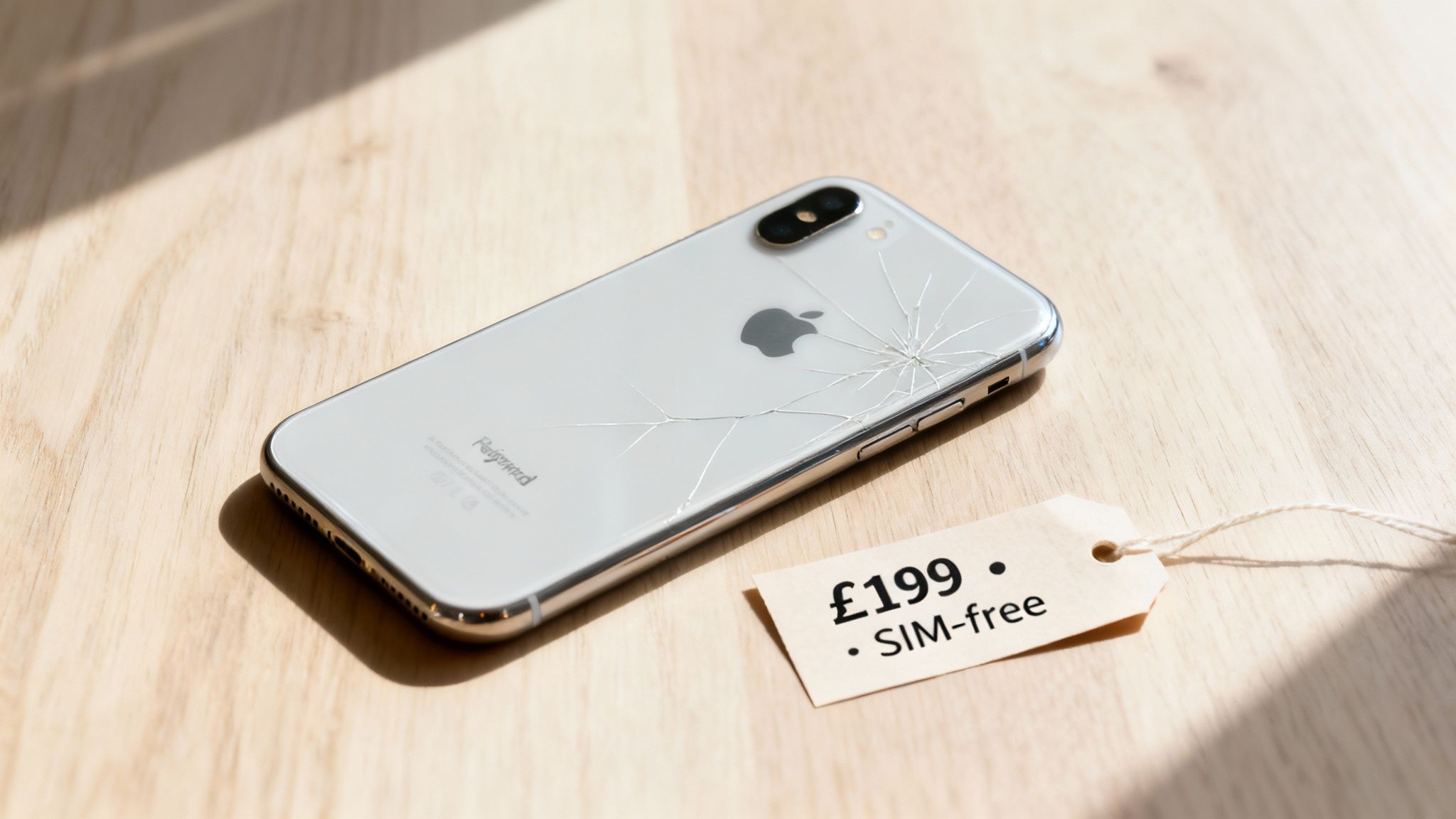
This guide will help you find a reliable, sim-free refurbished iPhone for under £200. It explains what to look for, how to understand seller grades, and what checks to make before you buy, so you can get a great mobile for a fair price.
Finding a good quality, sim-free refurbished iPhone for under £200 in the UK is absolutely doable, and you’re not just stuck with older models either. You can often find popular workhorses like the iPhone SE (2020), the ever-reliable iPhone 8, and sometimes even a well-looked-after iPhone X in this price bracket.
What a £200 Budget Really Gets You in the Refurbished iPhone Market
Buying a refurbished mobile isn't just a way to save cash; it’s a practical choice. You're giving a perfectly capable device a new lease of life, which is good for your wallet and helps to reduce e-waste.
The second-hand phone market is popular for this reason. You get a quality mobile without the high price tag, and we all contribute a little less to the growing amount of discarded electronics.
First, Let's Get the Lingo Right
Before we look at specific models, there are two key terms you'll see everywhere. Understanding these is the first step to finding the right mobile.
Refurbished: This isn't just a phone someone's pulled out of a drawer. A refurbished device has been professionally checked, tested, repaired if needed, and fully wiped of all previous data. Unlike a "used" phone from a private seller, a refurbished one comes from a professional seller and includes a warranty.
SIM-Free: This simply means the iPhone isn't tied to a particular network like EE, O2, or Vodafone. You can pop your own SIM card in—or find a new SIM-only deal—and it'll work straight away.
This combination of professional checks and network freedom makes finding sim free refurbished iphones under 200 pounds uk a great option for many people. It’s a good choice for a teenager's first mobile, a dependable backup for work, or for anyone who wants the Apple experience on a sensible budget.
In this price range, you’ll mainly find models that are a few years old but still perform well. They often still get the latest iOS updates from Apple and can handle everyday tasks like messaging, browsing, and social media without any issues.
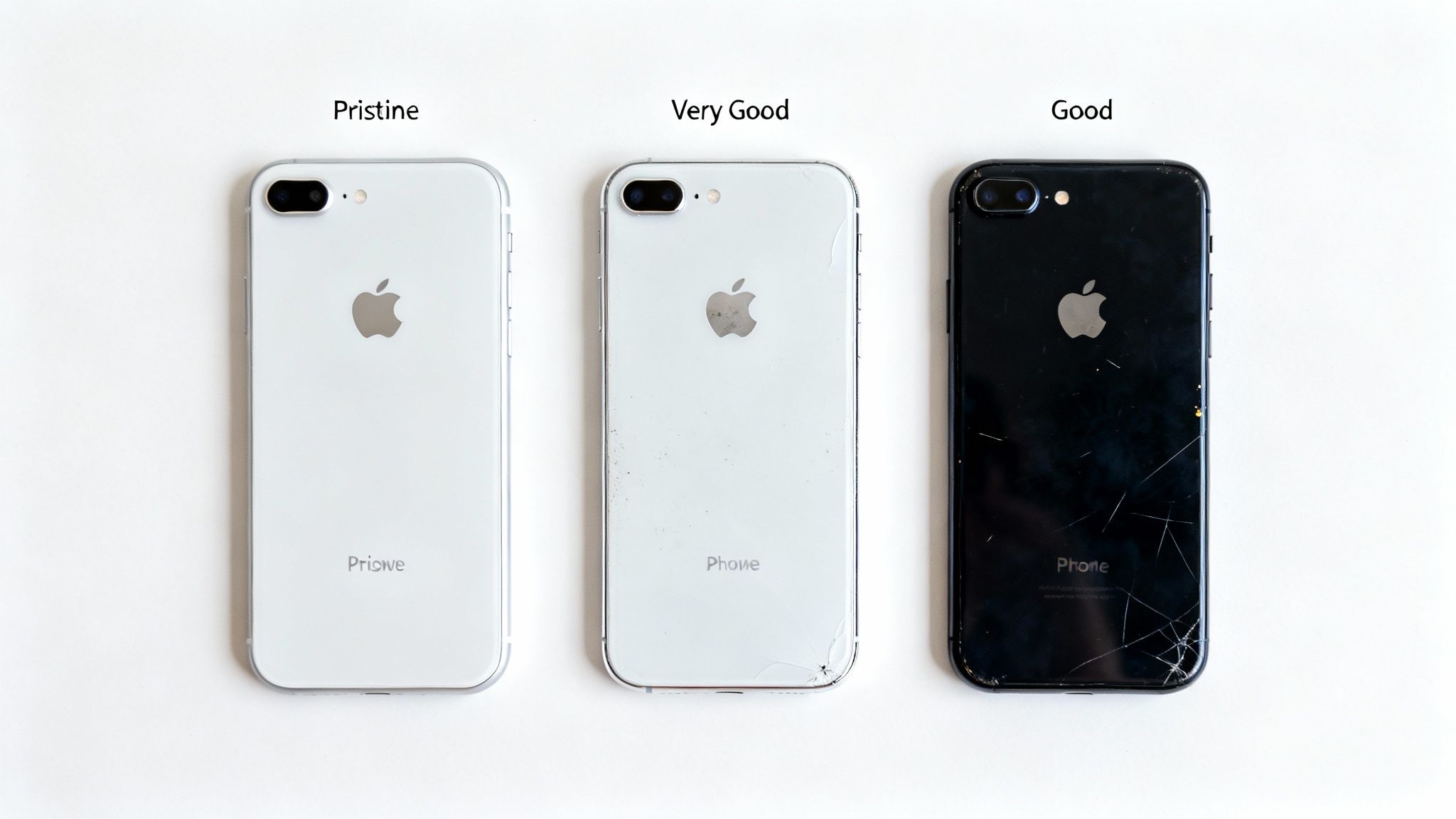
When you start shopping, you’ll see terms like 'Pristine,' 'Very Good,' and 'Good'. It helps to understand what these grades really mean, as they are almost entirely about the cosmetic condition of the phone, not how it works.
It’s important to remember this: no matter the grade, any phone from a reputable seller will be 100% functional. The grade just tells you what the phone looks like. A 'Good' grade iPhone will work just as well as a 'Pristine' one; it just has a few more signs of its previous life.
What Do the Grades Actually Mean?
While the names might differ slightly from seller to seller (some use A, B, C, for example), the standards are fairly consistent. Here’s a simple breakdown of what to expect from each grade.
Pristine (or Like New / Grade A): This is the top grade. The phone will look practically brand new, with no noticeable scratches or scuffs on the screen or body when held at arm's length.
Very Good (or Grade B): This is often a good balance of value and condition. A 'Very Good' iPhone might have some very light, minor signs of use, like faint scratches on the screen or small scuffs on the casing that are invisible when the screen is on.
Good (or Grade C): This grade offers the biggest savings. The phone will show moderate signs of wear and tear, like noticeable scratches on the screen and maybe a few scuffs or dings on the body. Crucially, none of these cosmetic marks will affect the phone's performance.
A Real-World Example
Let's imagine Alex needs a reliable mobile for their teenage son but doesn't want to spend a lot. They find two sim free refurbished iphones under 200 pounds uk—an iPhone SE (2020) graded 'Very Good' for £159, and the same model graded 'Good' for £139.
Alex knows his son will put the phone in a case straight away, so a few scratches on the back don't matter. By choosing the 'Good' grade, Alex saves £20 and gets a fully functional mobile that is perfect for his son's needs. The cosmetic marks are hidden by the case, and the phone works perfectly.
Getting your head around these grades is the key to finding the best value. For a deeper dive into how we assess these conditions, check out our complete guide to refurbished phone grading. It will give you the confidence to make a smart choice that fits your budget.
Your Essential Pre-Purchase Checklist
Before you click "buy", it's worth running through a few quick checks on the product listing. Getting these details right from the start can save disappointment later.
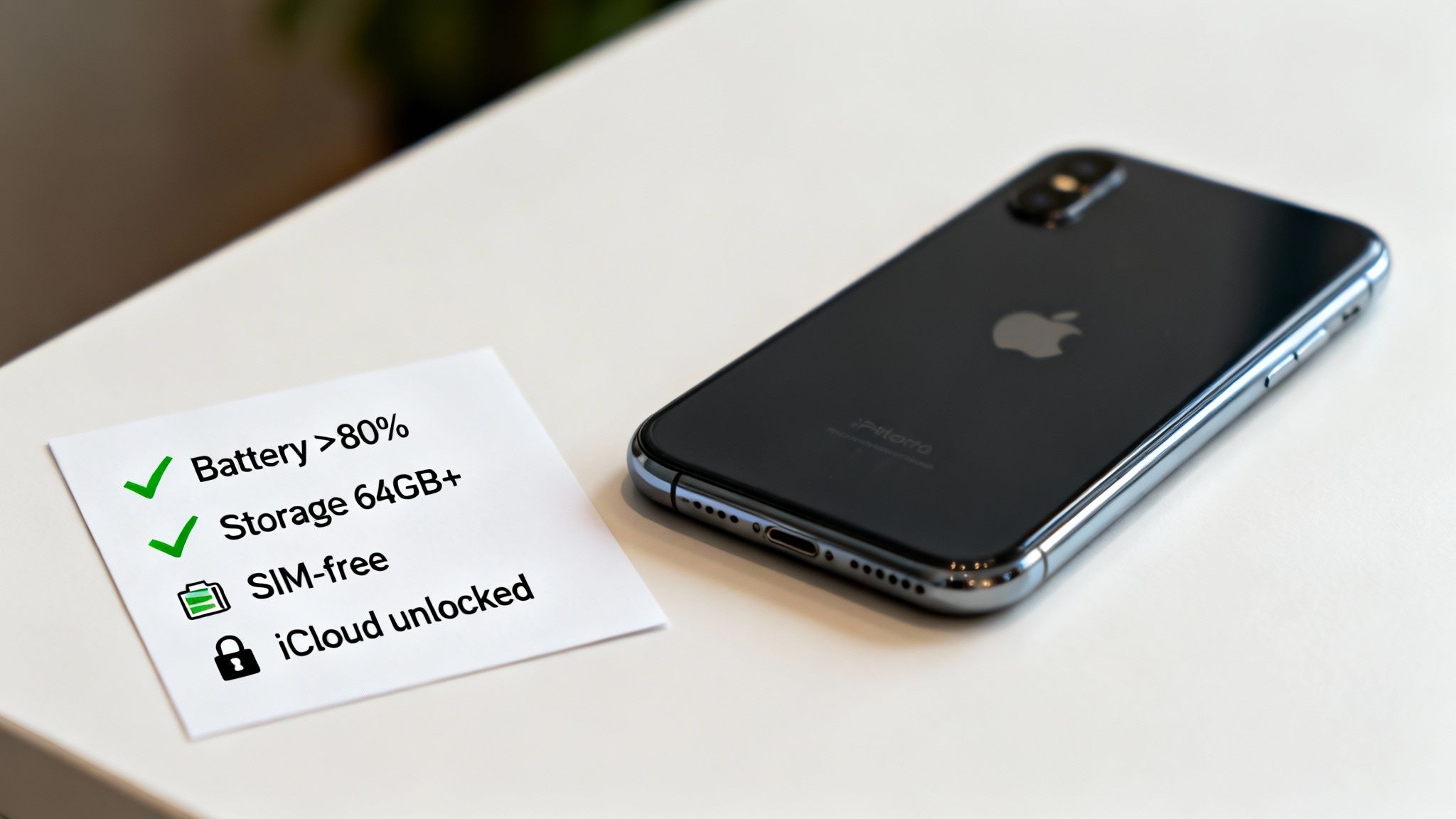
We’re going to look at four key areas: battery health, storage space, network status, and the iCloud lock.
Check the Battery Health Guarantee
An iPhone's battery health dictates how long you can go between charges. All batteries degrade over time, but a good refurbished phone should still have plenty of life left.
Reputable sellers will state a minimum guaranteed battery capacity. Look for a promise of 80% or higher. Apple considers a battery to be at good performance above this threshold. Anything less and you might find yourself needing to charge it more often.
On an iPhone, you can check this yourself by going to Settings > Battery > Battery Health & Charging. The ‘Maximum Capacity’ figure tells you its health relative to when it was new. Of course, you can't check this before buying, so the seller's guarantee is your assurance.
Is the Storage Capacity Right for You?
When you’re hunting for sim free refurbished iphones under 200 pounds uk, the most common storage size you'll see is 64GB. For many people, that’s fine for day-to-day use.
But what really matters is how you use your mobile.
Light User: If you mainly use it for calls, texts, web browsing, and a few apps, 64GB is probably more than enough.
Heavy User: If you shoot high-res photos and videos, download lots of large apps and games, or save films, that 64GB can fill up fast. In that case, see if you can find a 128GB model.
Thinking about your needs now can prevent the "Storage Almost Full" notification later on.
Confirm It’s Genuinely SIM-Free and Unlocked
The term ‘SIM-free’ means the phone isn’t tied to a specific mobile network like EE, Vodafone, or O2. This gives you the freedom to use a SIM card from any provider, which is perfect for finding the best SIM-only deals.
Sometimes you'll see it described as ‘unlocked’, which means the same thing. Whatever the wording, double-check the product description to make sure.
The Most Important Check: iCloud Activation Lock
This is the single most critical check. The iCloud Activation Lock is Apple's anti-theft feature, linking an iPhone to the owner's Apple ID. If the previous owner hasn't properly removed their account, the phone is completely unusable for you.
Warning: A refurbished iPhone with an active iCloud Lock cannot be activated or used. There is no workaround. You must ensure the seller guarantees the device is free from any iCloud or Apple ID locks.
Any professional seller will have checks for this, ensuring every device is fully wiped and reset. Buying from a trusted business that specialises in refurbished iPhones practically eliminates this risk, as it's a standard part of their process.
Pre-Purchase Checklist for Your Refurbished iPhone
Check
What to Look For
Why It Matters
Battery Health
A seller guarantee of 80% or higher minimum capacity.
Ensures the phone holds a decent charge and performs as expected.
Storage Space
At least 64GB, or 128GB+ if you're a heavy media user.
Prevents the frustrating "Storage Almost Full" error down the road.
Network Status
Explicitly stated as "SIM-free" or "Unlocked".
Gives you the freedom to choose any mobile network and find the best deals.
iCloud Lock
A clear guarantee that the device is free from any iCloud lock.
This is non-negotiable. An iCloud-locked phone is unusable.
Ticking off these four points is your best bet for a smooth, hassle-free experience.
Why a Warranty Is a Non-Negotiable Safeguard
A low price is always tempting, but it’s what happens after you buy that matters. A solid warranty and a clear returns policy are essential protections when buying a refurbished mobile.
A warranty protects you against hardware faults that aren’t your fault. If the battery suddenly fails or the speakers stop working a few months later, a good warranty means you won’t be left out of pocket. It’s the seller’s promise that the device they’ve sold you is in good working order.
What a Good Warranty Should Cover
When you’re looking at sim free refurbished iphones under 200 pounds uk, a 12-month warranty should be your minimum expectation. This is the industry standard for any reputable UK seller.
A typical 12-month warranty will cover things like:
Hardware Failures: Problems with internal components like the logic board, speakers, microphones, or the charging port.
Battery Defects: If the battery’s health drops significantly below its guaranteed level due to a fault (not just normal ageing), it should be covered.
Software Glitches: Issues with the phone's operating system that aren't fixed by a standard reset.
It's also important to understand what isn't covered. Warranties almost never include accidental damage (like a cracked screen from a drop), water damage, or issues caused by unauthorised repairs. For more details, see our guide on what’s covered in a refurbished phone warranty.
Understanding Your Return Rights
Alongside a warranty, a clear returns policy is crucial. This covers you if the phone isn't what you expected when it arrives. Always look for sellers offering at least a 14-day return period, a legal requirement for online sales in the UK. Many sellers extend this to 30 days.
This gives you a chance to hold the mobile, test its features, and make sure you’re happy with its condition. If you’re not satisfied for any reason, you can send it back for a full refund.
A strong warranty and a fair returns policy are the biggest advantages of buying from a professional refurbisher instead of a private seller.
How to Choose a Trustworthy UK Seller
Finding the right phone is only half the task. Picking the right seller is what really guarantees a good experience.
With so many options online, it’s important to know what to look for. This will help you spot the signs of a reliable UK-based seller, from their grading and warranties to their customer support.
Key Trust Signals to Look For
When you're browsing, certain things on a seller’s website should give you immediate confidence. These are clear signs of a professional and customer-focused business.
Keep an eye out for these essential trust signals:
UK-Based Operations: A clear UK address and phone number mean you’re dealing with a local business that operates under UK consumer law. It makes communication and any returns much simpler.
Transparent Grading System: A trustworthy seller will have a dedicated page clearly explaining their grading criteria, so you know exactly what to expect.
12-Month Warranty as Standard: A full year’s warranty shows the seller is confident in the quality of their refurbishment process.
Clear Returns Policy: Look for a minimum 14-day returns policy. This gives you time to properly check the device.
Positive Independent Reviews: Check reviews on platforms like Trustpilot or Google. Honest feedback from previous customers is one of the most reliable indicators of a seller's reputation.
Specialist Retailer vs Private Marketplace Seller
You might see what looks like a bargain on a site like Facebook Marketplace or Gumtree. While the price can be tempting, buying from a private individual carries risks that you don't face with a specialist refurbished phone business. The biggest difference comes down to accountability and expertise.
Think about the benefits of choosing a specialist business:
Data Security: A professional refurbisher uses certified software to securely wipe all data from a device. A private seller might just do a basic factory reset, which isn't always enough to permanently erase information. Our guide on how to factory reset an iPhone explains why this is so important.
Thorough Testing: Specialists conduct multi-point diagnostic checks on every device. A private seller can only tell you if it "worked fine" for them.
After-Sales Support: If you have an issue with a phone bought from a specialist, you have a warranty and a customer service team to turn to. With a private sale, you are usually on your own.
No Hidden Locks: A professional seller guarantees the phone is unlocked and free from any iCloud Activation Lock, a common issue when buying from private sellers.
By opting for a reputable business, you're investing in reliability and peace of mind. You get a fully tested device, a solid warranty, and the assurance that your purchase is protected by UK consumer rights.
Getting Your New Refurbished iPhone Set Up
Once your refurbished iPhone arrives, you’ll be up and running in just a few minutes. We'll walk you through the first simple steps, from inserting your SIM card to moving your data across from your old mobile.
First Steps Out of the Box
Before you turn the phone on, find the SIM tray on the side of the iPhone. Use the small SIM ejector tool (or a straightened paperclip) to pop the tray open. Place your SIM card inside and slide it back in.
With a sim-free refurbished iPhone, you're not tied to any network. This can be useful if you need to find the cheapest way to call internationally. Once the SIM is in, press and hold the side button to power up your iPhone.
The phone will boot up and an on-screen setup assistant will take you through the rest:
Choose your language and country.
Connect to a Wi-Fi network.
Set up Face ID or Touch ID.
Create a passcode.
Moving Your Data Across
Bringing over your contacts, photos, and apps from your old device is an important step. Before you start, it’s a good idea to make sure your old phone is fully backed up.
Warning: To avoid losing your personal information, always create a fresh backup of your old phone before you begin the transfer. You can do this by going to Settings > [your name] > iCloud > iCloud Backup and tapping Back Up Now.
During the setup process on your new iPhone, you’ll get to a screen called 'Apps & Data'. If you're coming from another iPhone, the 'Quick Start' feature is the easiest way. Just bring your old iPhone close to the new one, and it’ll guide you through the transfer.
For a more detailed look at all the options, our guide explains how to move everything from an old iPhone to a new one.
Got Questions? We’ve Got Answers
Thinking about buying a refurbished iPhone for under £200? It's a practical move, but you may have a few questions. Let's cover some of the most common ones.
What’s a Realistic Battery Life for a Refurbished iPhone Under £200?
Any reputable seller should guarantee a minimum battery health, usually 80% or higher. For models in this price range, like the iPhone 8 or SE (2020), that’s enough to get you through a full day of typical use. It will have been tested to make sure it holds a reliable charge.
Does SIM-Free Mean I Can Use the Phone Abroad?
Yes. 'SIM-free' means the iPhone isn't tied to a specific UK network. You can pop in a SIM card from any UK provider, and it’ll work straight away. This is also a bonus for travelling. When you arrive at your destination, you can buy a local SIM card and slot it into your phone to avoid high roaming charges.
Will My Refurbished iPhone Look Brand New?
This all comes down to the grade you choose. A top-tier ‘Pristine’ grade will look almost perfect. Realistically, in this price range, you’ll be looking at phones in ‘Very Good’ or ‘Good’ condition, which are fully functional but will show some light signs of use.
Very Good: Might have a few faint, light scratches on the screen or body.
Good: Will have more obvious signs of wear, like noticeable scratches or small scuffs.
A good seller will always give you a clear and honest description of what to expect.
Is Buying Refurbished Really Better for the Environment?
Yes, it makes a significant difference. Manufacturing a new smartphone is an intensive process that uses a large amount of energy and raw materials. By choosing a refurbished mobile, you’re giving a perfectly good device a second life. This directly reduces e-waste and lowers the carbon footprint associated with making a brand-new phone.
Written by James Waterston — 24 years in the mobile phone industry from customer service to Sales Director of a global repair & recycling company; now running Used Mobiles 4 U for 8+ years. LinkedIn
Order Today
By continuing to browse our site, you agree to the use of our cookies.
This website uses cookies to improve your experience while you navigate through the website. Out of these, the cookies that are categorized as necessary are stored on your browser as they are essential for the working of basic functionalities of the website. We also use third-party cookies that help us analyze and understand how you use this website. These cookies will be stored in your browser only with your consent. You also have the option to opt-out of these cookies. But opting out of some of these cookies may affect your browsing experience.
Necessary cookies are absolutely essential for the website to function properly. These cookies ensure basic functionalities and security features of the website, anonymously.
Cookie
Duration
Description
cookielawinfo-checkbox-analytics
11 months
This cookie is set by GDPR Cookie Consent plugin. The cookie is used to store the user consent for the cookies in the category "Analytics".
cookielawinfo-checkbox-functional
11 months
The cookie is set by GDPR cookie consent to record the user consent for the cookies in the category "Functional".
cookielawinfo-checkbox-necessary
11 months
This cookie is set by GDPR Cookie Consent plugin. The cookies is used to store the user consent for the cookies in the category "Necessary".
cookielawinfo-checkbox-others
11 months
This cookie is set by GDPR Cookie Consent plugin. The cookie is used to store the user consent for the cookies in the category "Other.
cookielawinfo-checkbox-performance
11 months
This cookie is set by GDPR Cookie Consent plugin. The cookie is used to store the user consent for the cookies in the category "Performance".
viewed_cookie_policy
11 months
The cookie is set by the GDPR Cookie Consent plugin and is used to store whether or not user has consented to the use of cookies. It does not store any personal data.
Functional cookies help to perform certain functionalities like sharing the content of the website on social media platforms, collect feedbacks, and other third-party features.
Performance cookies are used to understand and analyze the key performance indexes of the website which helps in delivering a better user experience for the visitors.
Analytical cookies are used to understand how visitors interact with the website. These cookies help provide information on metrics the number of visitors, bounce rate, traffic source, etc.
Advertisement cookies are used to provide visitors with relevant ads and marketing campaigns. These cookies track visitors across websites and collect information to provide customized ads.