We’d still buy a refurbished Galaxy S21 FE in the UK in 2026 if the price matches the grade and the seller is clear about battery health, warranty and returns. It remains a strong value phone, but weak batteries and vague grading can turn a bargain into a hassle.
Quick verdict
Best for buyers who want a bright screen, good cameras and Samsung flagship feel without paying new-phone money.
Not ideal for heavy users who dislike evening top-ups, or anyone chasing the newest model for longer-term peace of mind.
Typical UK refurbished price range is about £123 to £206, based on May 2026 UK listings.
A better alternative can be the standard S21 5G if we want to spend less, or the S22 if the gap is small.
The main risk is a tired battery, a worn USB-C port, or cosmetic grading that looks better in photos than in hand.
Our practical recommendation is to buy an Excellent grade, SIM-free unit from a UK refurbisher with a clear battery policy and at least a 18 Month Warranty.
Quick Comparison
Best overall value: Galaxy S21 FE (Excellent grade)
Cheapest alternative: Galaxy S21 5G
Best upgrade option: Galaxy S22 (if price gap is small)
Marketplace bargains can be rougher than they look, and a current eBay refurbished listing is a useful reminder that “refurbished” can mean very different things.
What to check on a refurbished Galaxy S21 FE before we buy
Price matters, but the seller’s standards matter more. In May 2026, UK asking prices generally sit between £123 and £206, and Smartphone Checker’s refurbished S21 FE deals page shows how much that can shift by grade.
We check three things first, battery policy, warranty length and return window. A proper refurbisher should also state whether the phone is unlocked, whether all cameras and biometric features work, and how its cosmetic grades are defined.
If a seller won’t state battery standards, grading rules and warranty in plain English, we move on.
After that, we look for the faults that affect daily use. Screen burn-in, uneven speakers, weak vibration, loose charging fit and poor-quality replacement screens all matter. None of those faults makes the phone worthless, but each one should change the price.
This is also where the S21 FE can lose its value edge. If a premium-grade unit gets too close to S22 money, it stops being the smart middle ground.
Our Experience Refurbishing This Model at Used Mobiles 4U
At Used Mobiles 4U, this model usually arrives in better shape than many cheaper Samsungs, but it still has clear patterns. Most stock we keep sits above 85% battery health, and the cleaner examples are often in the high-80s or low-90s.
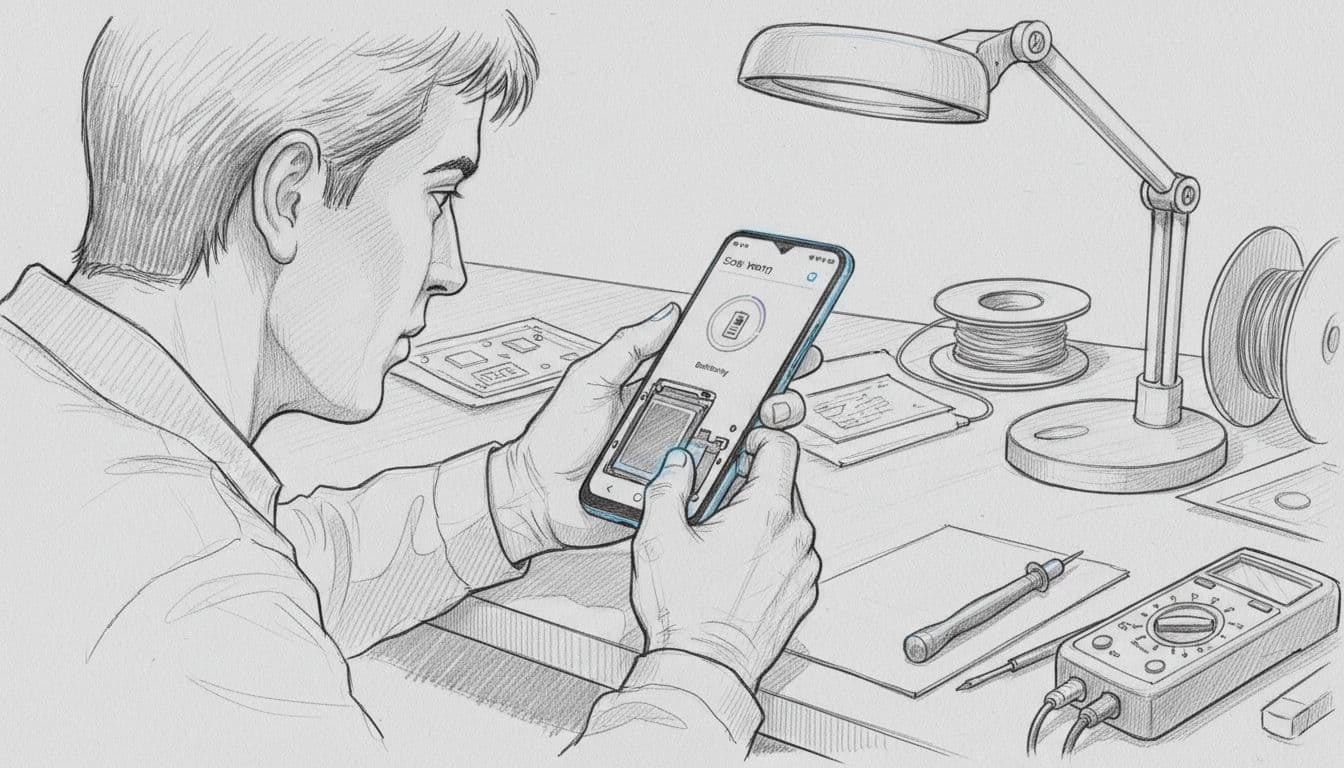
Our technicians often see worn USB-C ports on devices that have spent years charging in one spot. We also see scuffed frames, tired batteries, scratched camera rings and the odd display with faint image retention. Batteries and rear glass are among the parts we replace most often.
One thing we regularly notice is that grade gaps matter more on the FE than buyers expect. A Good grade can be a strong buy if the screen is clean and the battery is sound. An Excellent or Like New unit feels much better in hand because the frame picks up wear quickly, and that wear makes the phone look older than it performs.
Once the charging port, battery and display are right, reliability is generally good. Touch response, cameras and everyday speed tend to hold up well.
Real-world usage in 2026
In daily use, the S21 FE still feels quick. Messages, banking, maps, streaming, video calls and social apps run smoothly, and the 120Hz screen still helps the whole phone feel sharp.
Battery life depends more on health than age alone. With a healthy cell, most of us still get through a full day of mixed use. Heavy 5G, bright-screen video or long camera sessions can still mean a top-up by evening, so battery condition is not a box-ticking detail here.
The camera remains one of its best reasons to buy. Daylight photos are still crisp, skin tones are usually pleasing, and video is steadier than many cheap alternatives. Low-light shots show the phone’s age, yet it still beats plenty of budget Android models.
If we buy well now, a couple of comfortable years of use is a fair aim for most people.
Choose the S21 FE, S21, S22 or an iPhone
Choose the Galaxy S21 FE if we want the best balance of screen quality, camera quality and price.
Choose the standard S21 if we want a lower-cost flagship feel and can give up the FE’s value sweet spot.
Choose an iPhone if we prefer iOS, iMessage or stronger resale value. When we’re weighing refurbished iPhone vs Samsung under £300 UK, plus refurbished iPhones, used iPhones UK listings and other refurbished smartphones UK stock, Apple can be the safer fit.
Stay with Samsung if we’re also browsing cheap refurbished iPhones, refurbished iPhone deals UK shops promote, or second hand iPhones UK marketplaces, but we still want a smoother display and flexible camera setup.
If we were about to buy refurbished iPhone stock only because it feels familiar, the S21 FE is worth a proper side-by-side look first.
Final thoughts
The S21 FE still earns its place in 2026 because it gets the basics right, screen, camera and everyday speed. The catch is simple: we need to buy on condition, not headline price.
For most UK buyers, an Excellent grade unit from a seller with a clear battery standard is the safest choice. If you’re unsure whether the FE, a plain S21 or an iPhone makes more sense, we’re always happy to help.
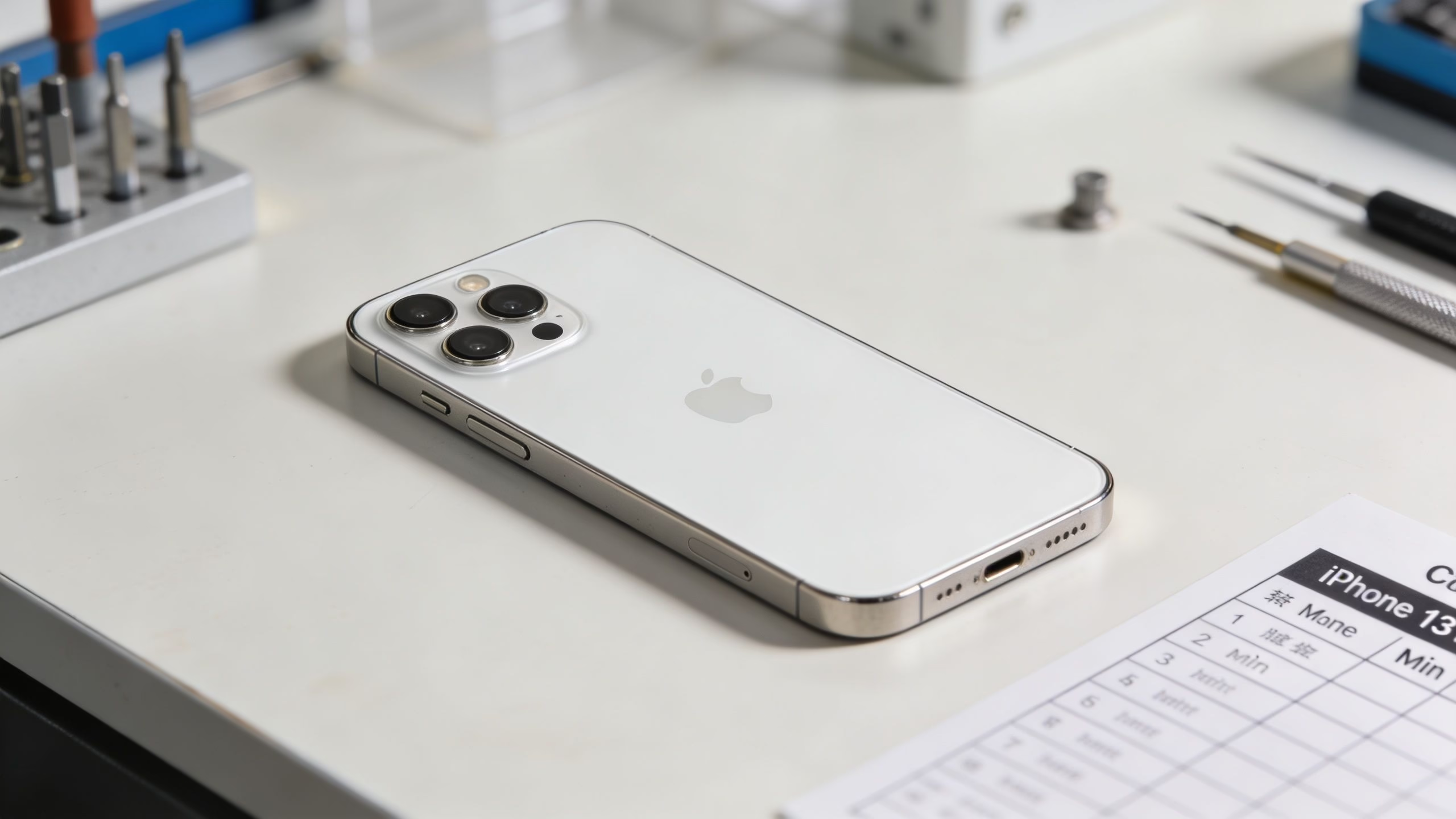
If you're shopping for a refurbished iphone 13 mini, you're probably in one of two camps. You either miss having a small iPhone that still feels quick, or you want a sensible upgrade without paying new-phone money. Both are fair reasons.
The short answer is this. The iPhone 13 mini is still a practical buy in 2026 if you value size, performance, and iOS support more than all-day heavy battery life. It still has the A15 Bionic chip, solid cameras, 4K video recording, Cinematic mode, and projected software support until at least 2028 based on Apple support information for the model family and its hardware platform, as noted on Apple’s iPhone 13 technical specifications. The main trade-off is battery. A mini is efficient, but it has less physical battery capacity to work with than a larger handset, so long-term ownership needs a bit more thought.
That’s the part many buyers don’t hear enough about. A tidy-looking handset can still need a battery sooner than expected. So the smart way to buy isn’t just checking the price. It’s checking the seller, the grade, the battery health, and what happens if the phone isn’t right when it arrives.
Thinking About a Refurbished iPhone 13 Mini?
A lot of people looking at this phone are replacing something larger that feels awkward in the pocket, or they’re moving on from an older iPhone that’s become slow, worn, or expensive to repair. The appeal of the iPhone 13 mini is simple. It’s compact, familiar, and still properly capable for everyday use.
Refurbished iPhone 13 Mini Buyer's Guide (2026) 15
If you want a phone that’s easy to use one-handed and still feels modern, this is one of the few models that really fits. What matters is buying it with your eyes open. Refurbished can be a very sensible route, but the quality of refurbishment varies a lot between sellers.
It also helps to budget for the full ownership picture, not just the checkout price. If you're trying to balance a phone purchase with other monthly costs, these actionable tips for budgeting are useful for planning around setup costs, accessories, and any future battery replacement.
A small phone can be a great buy. A small phone with a tired battery can become frustrating very quickly.
The good news is that the iPhone 13 mini still makes sense for a lot of UK buyers. The key is knowing what refurbished means, and where corners are sometimes cut.
What 'Refurbished' Really Means
A refurbished iPhone 13 mini should arrive as a checked, tested handset, not just a second-hand phone that has been wiped and boxed again. That distinction matters more with the 13 mini than with larger iPhones, because a phone can look clean on the outside and still be close to the point where battery performance becomes annoying and expensive to sort out.
A private seller can describe a phone as “excellent” and still miss the things that cause trouble later. I see the same pattern often enough. Light wear is rarely the problem. Short battery runtime, poor-quality past repairs, weak charging contacts, unreliable Face ID, or a speaker fault are what turn a cheap buy into a frustrating one.
Refurbished iPhone 13 Mini Buyer's Guide (2026) 16
What a proper refurbishment process includes
In workshop terms, proper refurbishment usually means the phone has been processed through a set routine before sale, including:
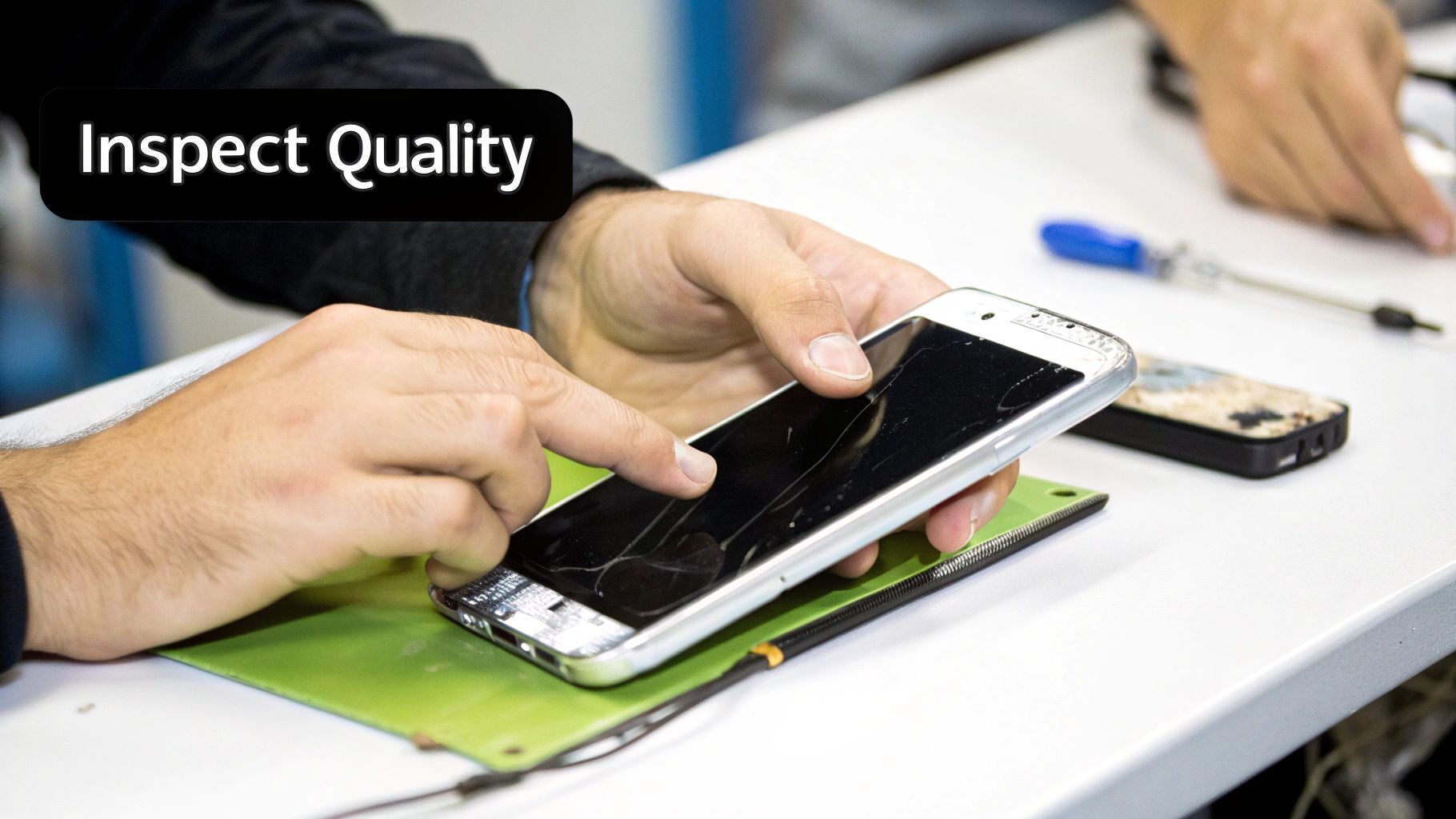
Functional testing The seller should check touchscreen response, cameras, microphones, speakers, Face ID, charging, buttons, Wi-Fi, Bluetooth, and mobile signal performance.
Battery assessment On an iPhone 13 mini, this needs more than a quick glance at the battery percentage in settings. A responsible seller should set a clear battery standard and be honest if the handset is still on an older cell that may need replacing sooner than a buyer expects.
Secure data wiping The previous owner’s data should be removed properly, with handling that meets UK data protection expectations.
Cosmetic grading Grade should describe appearance only. Scratches on the frame and marks on the screen are cosmetic. They are not a substitute for confirming the phone works properly.
Final quality control A phone should be checked again before dispatch so faults like intermittent charging, camera shake, or a crackling earpiece are caught before they reach the customer.
Good refurbishment is really about process control. If a seller cannot explain what was tested, what parts were replaced, what battery standard they use, and what happens if a fault shows up after delivery, the word “refurbished” is doing too much work on its own.
Why grading matters more than the word refurbished
The label is only the start. One company’s “excellent” can be another company’s “good”, and the grade often says nothing about whether the battery is still strong enough for a compact phone you plan to keep for two or three years. That is why I always tell buyers to read the grading notes and battery policy together, not separately. If you want a clearer breakdown of the labels, this guide on refurbished phone grades explained is useful.
A tidy casing does not tell you much about long-term ownership. On the 13 mini, battery condition has a bigger effect on day-to-day satisfaction than a couple of marks on the aluminium frame.
Practical rule: Buy from the seller who explains their testing and battery policy clearly, not the one with the nicest adjective in the title.
What doesn’t count as proper refurbishment
A few warning signs come up again and again:
Only cosmetic detail If the listing talks at length about scratches but says little about testing, repairs, or battery standards, that is a weak listing.
No clear battery threshold or replacement policy This matters on any used phone. It matters even more on a mini, where battery decline is felt sooner in real use.
No mention of warranty or returns That usually leaves you carrying the risk if the phone develops a fault after a few days.
Vague wording or stock-only photos “Good for age” and “fully working” are too loose if there is no explanation behind them.
The useful way to read “refurbished” is simple. It should mean the phone has been inspected, cleaned, graded, data-wiped, tested, and backed by a returns process. If it only means “pre-owned and switched on”, price alone is not enough reason to buy it.
Why Choose a Refurbished iPhone 13 Mini in 2026
You notice the iPhone 13 mini most after a few months of ownership, not on day one. It slips into any pocket, works properly with one hand, and still feels quick. Then real use starts to separate good purchases from bad ones. On this model, that usually comes down to whether you bought the right refurbished example, with the right battery policy, at the right price.
The 13 mini still has a clear place in 2026 because Apple never replaced it with another small flagship iPhone. If you want a genuinely compact iPhone without dropping back to something much older, this is the model that keeps coming up for good reason.
What still makes it worth buying
Performance is not the problem here. The A15 chip still handles messaging, maps, banking apps, photos, streaming, and everyday multitasking without feeling dated. The camera setup is still strong enough for most buyers, and the phone keeps the premium feel people expect from a main iPhone rather than a backup device.
That is a key differentiator, as many compact phones feel small and underpowered. The 13 mini does not. In use, it feels like a proper high-end iPhone in a smaller shell.
It also sits in a useful middle ground on price. New old stock, where it appears at all, often costs more than it should because the mini is discontinued. A refurbished one usually makes better sense. You get the same core phone, the same compact form factor, and you avoid paying extra for shrink wrap.
Who tends to be happiest with it
The best fit is usually quite specific:
Buyers who are tired of carrying a large phone If a Pro Max or Plus-sized handset already feels awkward in a pocket or one hand, the 13 mini fixes that immediately.
People upgrading from an older iPhone SE, 11, or 12 mini The jump feels familiar rather than disruptive, but still more polished.
Anyone who values size over screen area Some buyers want a phone that stays out of the way. The 13 mini is one of the last iPhones that effectively does that.
The trade-off that matters in long-term ownership
The part many listings gloss over is battery reality.
A compact phone always has less room for battery capacity. On a brand-new mini, that is manageable. On a refurbished mini in 2026, the ownership experience can change a lot depending on how the previous owner charged it, how hard it was used, and whether the battery has already lost enough health to be noticeable in daily life. Two iPhone 13 minis can look identical in photos and feel very different by 4pm.
That is why this model rewards careful buying more than casual bargain hunting. A cheaper handset can stop looking cheap once you factor in an earlier battery replacement, reduced screen-on time, or the hassle of sending it back.
Why refurbished often makes more sense than boxed stock
For the 13 mini, refurbished is often the more practical route, not the compromise route. This is a mature model with known strengths and known weak points. Sellers have had time to sort, test, and price these properly. Buyers also have enough market history now to judge whether the saving is real or whether a listing is just cheap for a reason.
I usually tell people to treat this model as a long-term fit decision. If you know you want the last small iPhone that still feels current, refurbished is often the sensible way in. Just keep your attention on battery standard, return policy, and price relative to condition, not just the headline saving. If you want a clearer view on cosmetic differences before you compare listings, this guide to understanding refurbished iPhone quality is worth reading first.
Understanding Condition Grades and Pricing
One of the biggest mistakes buyers make is assuming condition grade tells them everything. It doesn’t. A grade mainly tells you how the phone looks on the outside. It should not mean one grade works properly and another doesn’t. If the refurbishment has been done correctly, every grade should be fully functional.
That’s why a lower cosmetic grade can sometimes be the smarter buy. If the phone is going straight into a case and screen protector, paying extra for a near-pristine finish might not matter much.
Refurbished Condition Grades Explained
That table is the practical version. The important thing is that cosmetic wear should never mean hidden faults are acceptable.
How to think about value
The refurbished market in the UK shows a fairly wide spread depending on condition, battery state, and who is selling the handset. The right way to compare listings is not just “which one is cheapest?” but “which one gives me the best balance of condition, battery, and after-sales cover?”
Here’s how I’d usually frame it:
Like New Worth considering if marks on the frame or screen will bother you every day.
Very Good Often the sweet spot. You save some money, but the handset still looks tidy enough for most buyers.
Good Usually the best value if you’re practical about appearance. A lot of these phones look absolutely fine once cased.
A parent buying a phone for a teenager often lands on Good condition for exactly that reason. The mobile gets protected on day one, and the saving matters more than a flawless finish.
Don’t confuse price with total cost
Certain situations can put buyers at a disadvantage. A cheaper phone with a battery that soon needs replacing can end up costing more overall than a slightly more expensive one in better health. The same applies if the seller makes returns awkward or offers little support.
Cosmetic grade affects what you see. Battery condition affects how the phone feels to own.
A simple buying mindset
When comparing two refurbished iPhone 13 mini listings, I’d ask:
Does the grade match what I’m happy to look at every day?
Is the battery standard clear?
Is there a proper return window?
Is the saving enough to justify the lower grade?
That usually gets buyers to a better decision than staring at product photos and hoping for the best.
The Reality of iPhone 13 Mini Battery Life
You buy a refurbished iPhone 13 mini because you want a phone that fits in one hand, disappears into a pocket, and still feels fast. Six months later, the question is not whether it looks good. It is whether it still gets through your actual day without a late-afternoon charge.
Refurbished iPhone 13 Mini Buyer's Guide (2026) 17
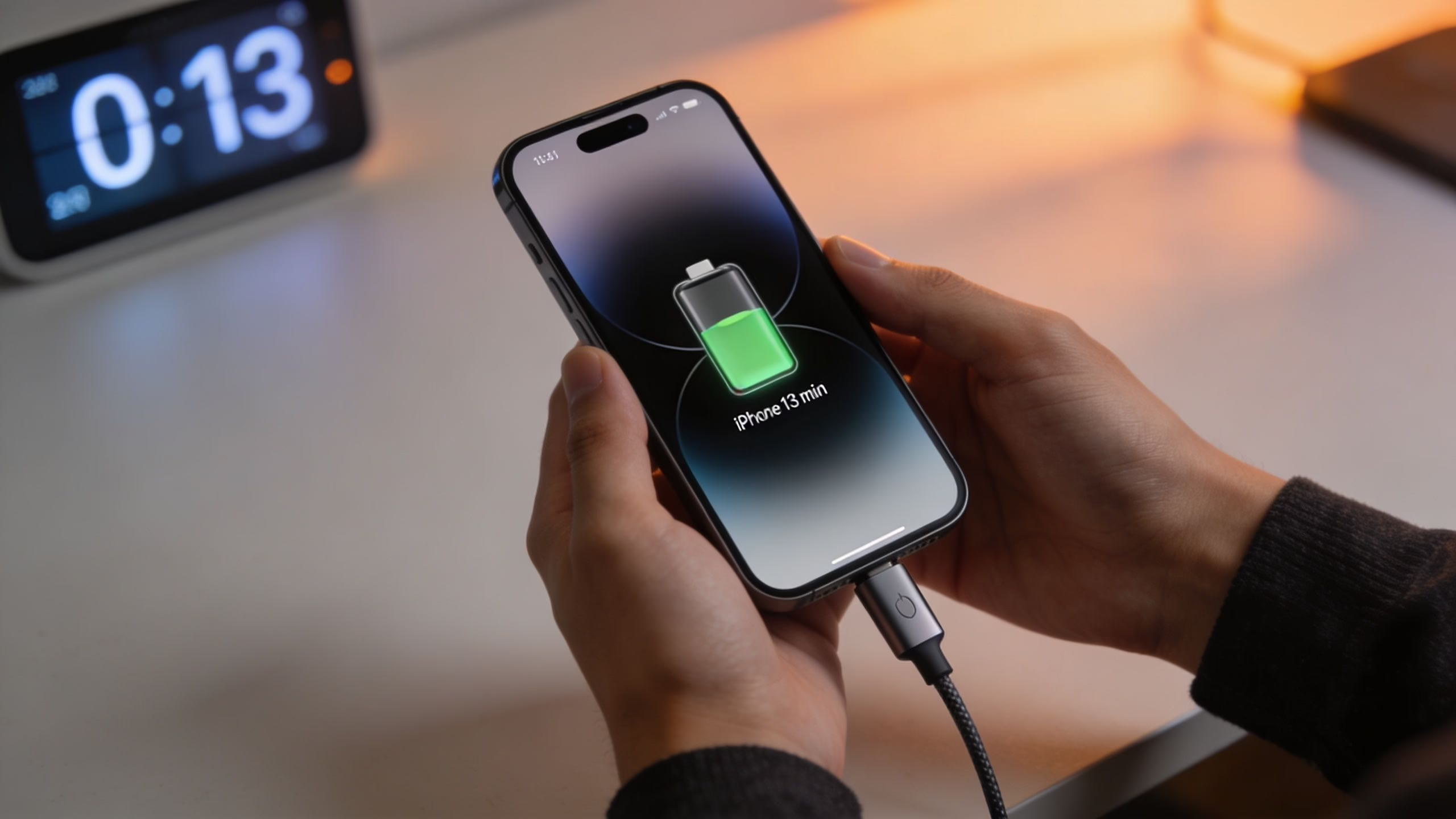
That is the main trade-off with the 13 mini. The phone itself has aged well. The battery has less margin than the larger iPhone 13, so any wear shows up sooner in daily use. A handset at 88% health can still be perfectly usable, but on this model the gap between "fine" and "annoying" is smaller than many buyers expect.
Why the mini feels battery wear sooner
The iPhone 13 mini has a 2406mAh battery. That smaller cell is the cost of getting a compact iPhone.
On a larger model, battery decline can be easier to live with because there was more capacity to start with. On the mini, the same percentage drop tends to be more noticeable in everyday use. You will feel it first on heavy-use days: 5G, navigation, camera use, video, hotspot, or long stretches away from a charger.
This is why I tell buyers not to treat battery health as a box-ticking exercise. The number matters, but the ownership pattern matters more.
What to look for beyond the battery percentage
A clear battery threshold from the seller helps, but it does not tell the whole story. A 13 mini with decent health and light use can still be an excellent buy. A 13 mini used hard every day will expose its limits faster, even if the condition grade looks great.
What tends to work well:
Buy with your usage in mind Calls, messages, music, browsing, and light social use suit this phone well.
Budget for ownership, not just purchase price If you plan to keep it for a couple of years, a later battery replacement is part of the calculation.
Prioritise battery honesty over cosmetic perfection A cleaner frame does not improve screen-on time.
What catches buyers out:
Expecting it to behave like a bigger iPhone It will not. The mini is a convenience phone first, an endurance phone second.
Buying the cheapest listing without asking about battery policy Saving money upfront can disappear if the battery feels tired within months.
Judging the phone only on day-one setup A battery can seem acceptable during the first evening, then feel tight once normal routine starts.
The long-term cost is part of the decision
This is the part buyers often miss. With a refurbished iPhone 13 mini, battery replacement is not an edge case. For many owners, it is a likely maintenance cost during the life of the phone.
Plug notes that battery issues are one of the more common complaints with refurbished phones, and replacement for this kind of model can add roughly £70 to £100 to your total ownership cost (Plug battery checklist reference). That does not make the 13 mini poor value. It means the smart way to price one is purchase cost plus probable battery work later.
I have had buyers ask whether 85% battery health is good enough. Sometimes yes. For lighter use, it can still be a sensible buy. For long workdays, frequent 5G use, maps, video, or lots of photos, 85% on a mini can start to feel restrictive much sooner than the same figure would on a larger handset.
If you want a more model-specific breakdown of what those battery health numbers mean in practice, this Used Mobiles 4 U iPhone 13 guide is a helpful reference.
A 13 mini with honest battery performance is usually the better buy than a cleaner-looking one that needs charging before dinner.
How to Inspect Your Phone When It Arrives
Once your phone lands, don’t just admire it and move on. Check it properly while you’re still within the return period. That gives you confidence, and it gives you a clear basis for contacting the seller if something isn’t right.
Refurbished iPhone 13 Mini Buyer's Guide (2026) 18
Start with the physical checks
Before you sign into everything, look over the handset carefully.
Check the grade match Does the screen and frame look like the condition you paid for?
Look at the camera lenses Tiny cracks, haze, or deep scuffs can affect photos.
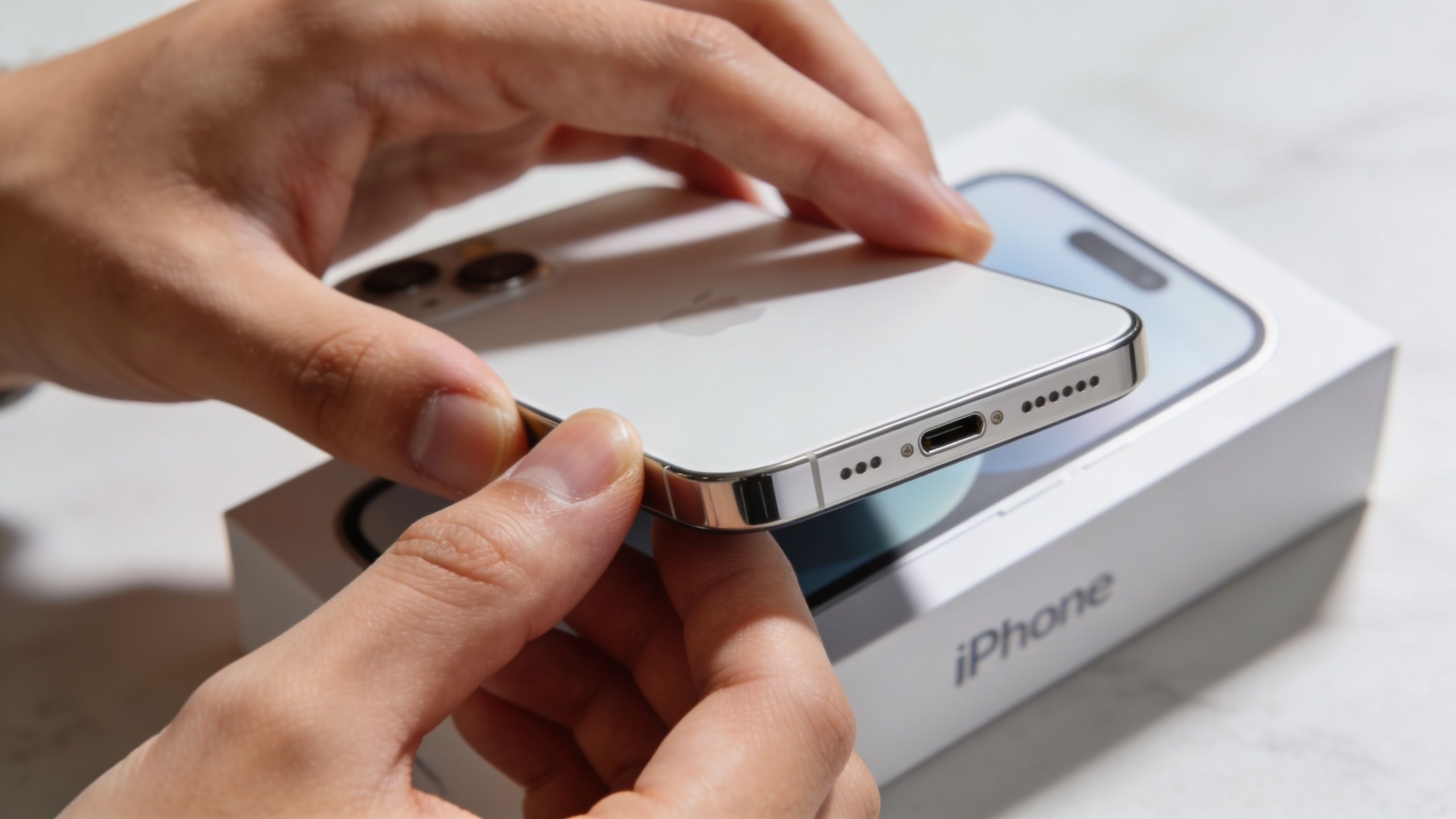
Inspect the charging port and speaker holes They should be clean and not packed with lint or debris.
Press every button Volume, side button, mute switch. They should all feel positive and even.
A few light marks might be normal, depending on grade. Loose buttons, lifting screen edges, or obvious repair gaps are not.
Run the main function tests
Once the handset powers up, go through the basics in a deliberate order.
Check battery health Go to Settings > Battery > Battery Health & Charging and look at Maximum Capacity.
Test Face ID Go to Settings > Face ID & Passcode and try to set it up.
Make a test call Check the earpiece, microphone, and loudspeaker.
Test Wi-Fi and mobile signal Join your network and browse normally.
Try the cameras Take photos with the front and rear cameras. Record a short video and play it back.
Plug in a charger Make sure charging starts properly. If you have a wireless charger, test that too.
Check sound Play music or a video and listen for distortion or crackling.
Screen and sensor checks
The display is one of the most expensive parts to put right, so spend a moment on it.
Open a bright white image or a plain light screen and look for:
Discolouration
Dead pixels
Dark patches
Touch issues around the edges
Then rotate the screen, open and close apps, and swipe around the keyboard. If touch feels inconsistent, don’t ignore it.
If something feels off on day one, report it on day one. Waiting usually makes returns harder, not easier.
Before data transfer and reset steps
If you’re moving from an older iPhone, back up first. That’s not optional. Any setup issue, reset, or restore attempt can put data at risk if you haven’t done a proper backup.
Use either:
Settings > [your name] > iCloud > iCloud Backup
A computer backup through Finder or iTunes, depending on your setup
A customer recently contacted us after receiving a refurbished iPhone with Face ID not completing setup. Everything else worked, but that one fault was enough to justify getting in touch with the seller straight away. That’s exactly why these checks matter. Small issues are easiest to sort when they’re identified immediately.
A quick arrival checklist
If you want a simple pass-or-fail view, check these before settling in:
Battery health shown and acceptable
Face ID sets up
Rear and front cameras work
Calls sound clear both ways
Charging works properly
Wi-Fi connects normally
Screen responds evenly
Condition matches grade
If all of that checks out, you can start setting it up with a lot more peace of mind.
Warranty Returns and Finding a Trusted Seller
If I had to rank what matters most when buying a refurbished iPhone 13 mini, warranty and returns would sit near the top. Not because faults are guaranteed, but because you need a safety net if one appears.
A phone can pass initial checks and still show a hidden issue later. Batteries can become unstable. Cameras can fail. Charging faults can be intermittent. When that happens, the seller’s after-sales support matters far more than a polished product listing.
What a trustworthy seller should make clear
You shouldn’t have to dig through tiny print to find the basics.
Look for:
A clear warranty It should explain what hardware faults are covered and what isn’t.
A readable returns policy You need to know how long you have to inspect the phone and what condition it must be returned in.
Battery expectations Not every seller handles this the same way, so transparency matters.
A real support route Email-only support isn’t always a problem, but clear UK-based contact details help.
Why private sales are different
A marketplace deal can look cheaper, but once the money’s gone, so is most of your protection. If the battery drains rapidly or the camera starts failing, you may be left arguing with a stranger who has no obligation to help.
That’s the key difference with an established retailer. The process is usually slower and more formal, but there’s accountability behind it.
At retail level, I’d generally rather see a modestly priced phone from a seller with proper testing and support than a cosmetically cleaner phone from a vague listing. Used Mobiles 4 U is one UK retailer that states its devices are tested, data-wiped, graded, and supplied with a 18 Month Warranty and returns policy, which is the sort of framework buyers should look for when comparing refurbished options.
The best return policy is the one you never need. The second best is one that’s easy to use when you do need it.
A note on getting help after purchase
Sometimes buyers also want support for the wider Apple setup around the phone, especially if they use other Apple devices. If you rely on a Mac as part of your backup or transfer process and need outside help, services like convenient Mac repairs by Nerds 2 You can be useful for general Apple hardware support. That’s obviously separate from a UK phone seller’s warranty, but it’s still worth knowing where to get help if your wider setup has issues.
A trusted seller won’t just ship the phone and disappear. They’ll make it clear what happens if the device isn’t as described, develops a fault, or doesn’t suit you.
Final Advice from Our Team
The refurbished iphone 13 mini still makes sense for the right buyer. If you want a compact iPhone that feels fast and familiar, it’s a strong option. Just be realistic about the battery, check the grade properly, and buy from a seller that explains testing, warranty, and returns clearly.
If you’re choosing between appearance and long-term value, I’d usually prioritise battery honesty and after-sales support first. Those two things shape the ownership experience far more than a couple of light marks on the frame.
Written by James Waterston, 24 years in the mobile phone industry from customer service through to Sales Director of a global repair and recycling company. Now running Used Mobiles 4 U for over 8 years.
If you’re still unsure whether a Used Mobiles 4 U refurbished iPhone 13 mini is the right fit, the team can help you compare grades, battery expectations, and other refurbished models in plain English.
This guide explains what the term 'refurbished iPhone' really means. We'll show you how a refurbished mobile compares to a 'used' one from a private seller, what checks it goes through, and what you should look for to make a smart purchase.
Simply put, a refurbished iPhone is a pre-owned device that's been professionally inspected, tested, repaired, and cleaned to bring it back to full working order.
Crucially, it is sold with a warranty and has had all previous data securely wiped. This gives you a level of confidence you don't get when buying directly from an individual.
So, What Is a Refurbished iPhone, Really?
When you hear ‘refurbished iPhone’, don't just think of it as any old second-hand mobile. A better way to look at it is like a certified pre-owned car from a reputable dealership. It's not fresh off the factory line, but a team of technicians has checked the engine, tested the brakes, and made sure every dial and button works perfectly.
That professional process is what makes all the difference. Unlike buying a used mobile directly from someone online—where it’s sold ‘as is’—a refurbished iPhone goes through a meticulous checklist of functional tests and repairs. A specialist business makes sure the device you receive is reliable and ready to go.
What Sets a Refurbished iPhone Apart?
Let’s break down what you can expect when you see that ‘refurbished’ label from a professional seller. It’s more than just a quick polish.
Comprehensive Testing: Every part of the phone—from the battery health and screen responsiveness to the cameras, speakers, and microphones—is put through its paces to ensure it functions as it should.
Professional Repairs: If any components don't pass the tests, they are repaired or replaced with high-quality parts. This brings the device back up to its original standard.
Secure Data Wipe: The phone is professionally wiped clean of all data from the previous owner using industry-standard software. This protects their privacy and gives you a completely fresh start.
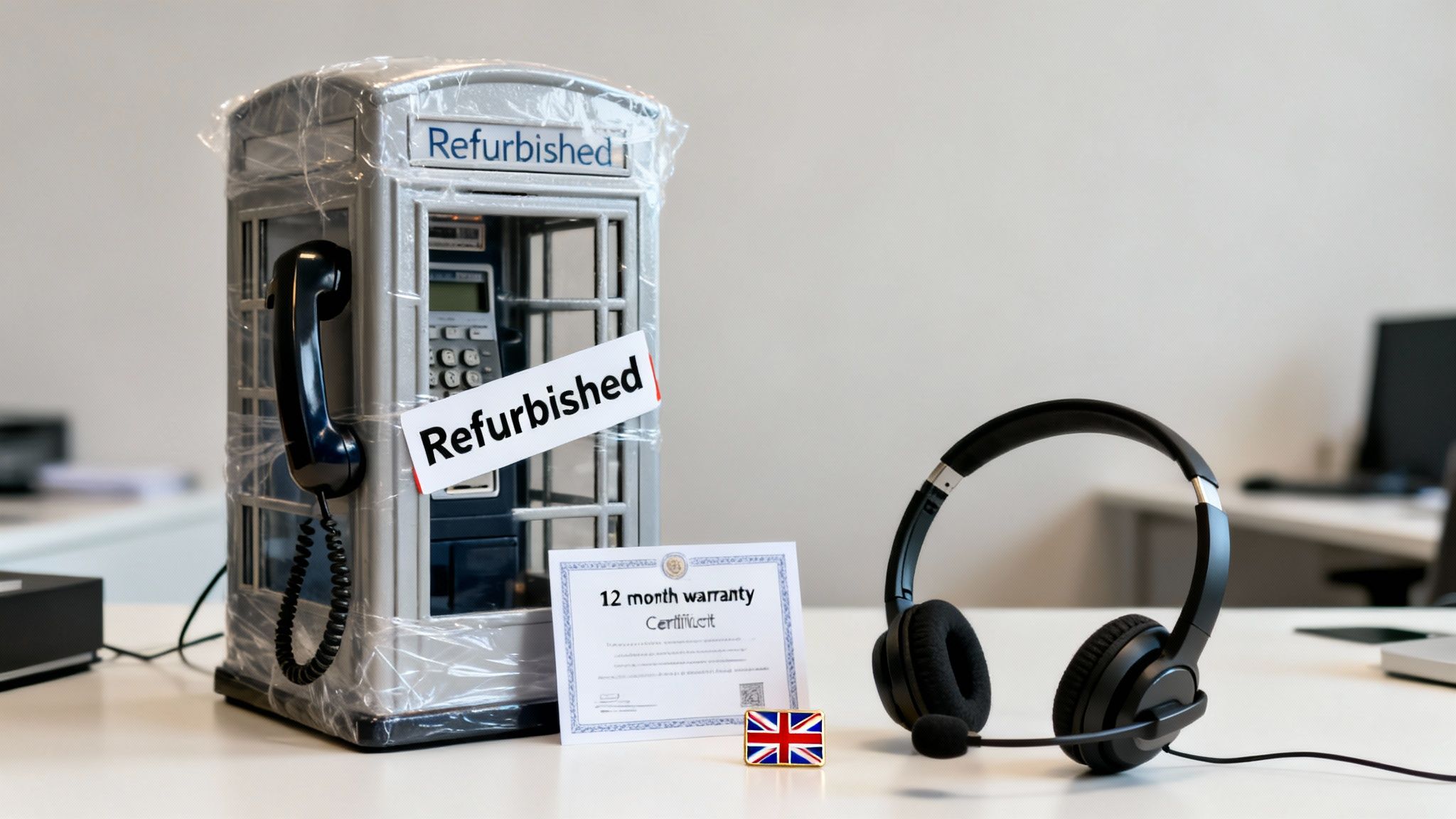
A Solid Warranty: This is a big one. Reputable sellers always include a warranty, which is typically for 12 months. This protects your purchase against any faults that might pop up later on. You can read our guide to warranties for refurbished iPhones to learn more.
A Realistic Example
Imagine Sarah wants to get her teenage son his first iPhone but can't quite stretch to the cost of a brand-new model. She spots a cheap "used" one on a marketplace site but feels uneasy about its history and the fact there’s no guarantee if something goes wrong.
Instead, she opts for a refurbished iPhone from a trusted UK seller. She saves money, gets a phone that has been professionally checked and cleaned, and—most importantly—it comes with a 18 Month Warranty. That provides real peace of mind.
This is exactly why refurbished is such a smart choice: it offers a safe, reliable middle ground between the high cost of new and the gamble of buying used.
The Journey from Pre-Owned to Professionally Refurbished
Ever wondered what actually happens to a phone after it’s traded in? It’s easy to assume it just gets a quick wipe-down before being put back on sale, but the reality is far more thorough. Understanding this journey is key to knowing what refurbished iPhone means for you.
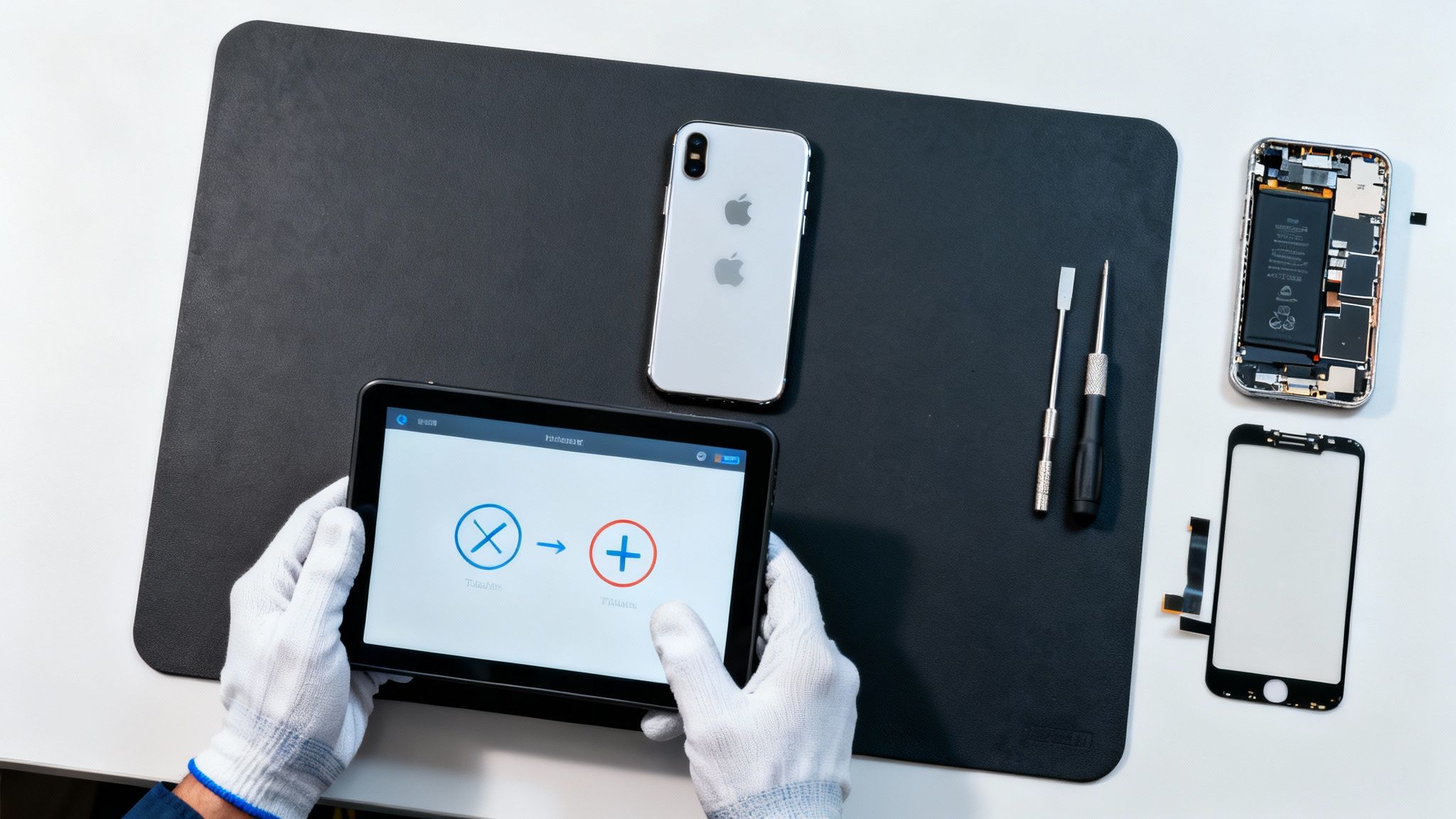
When a pre-owned iPhone lands at a specialist facility, its first stop is the diagnostic bench. A technician hooks it up to advanced software that runs a full check on dozens of functions. It’s an exhaustive test covering everything from battery health and screen responsiveness to the performance of the cameras, speakers, and even the vibration motor.
What a Refurbished iPhone Means in the UK 28
From Faults to Full Functionality
If that diagnostic test flags up any problems, that's when the real restoration work begins. A technician will carefully replace any part that isn't up to scratch.
Battery Replacement: This is a common step. If a battery's health has dipped below a certain point (usually around 80-85% of its original capacity), it gets swapped out for a high-quality new one. This ensures the phone you get holds its charge properly.
Screen and Component Repairs: It could be a minor screen scratch, a faulty charging port, or a button that doesn't feel quite right. Any imperfect component is replaced to bring the phone back to full working order.
This professional repair process is a massive part of what refurbished iPhone means. It’s what separates it from a "used" phone sold by a private seller, where you have no idea about its history or hidden faults. It’s a guarantee that the device is fully functional.
Secure Data Wiping and Final Checks
With the hardware sorted, the next step is crucial for privacy: a secure data wipe. Technicians use approved software to completely erase all data from the previous owner. This is far more powerful than a simple factory reset, making sure no trace of personal information can be recovered.
Once wiped, the phone is thoroughly cleaned. The final step is giving it a cosmetic grade based on its physical appearance—we'll get into that in the next section. For a deeper dive into the technical side, you can learn more about how iPhones are refurbished in our specialist guide.
Decoding iPhone Grades: What Do They Really Mean?
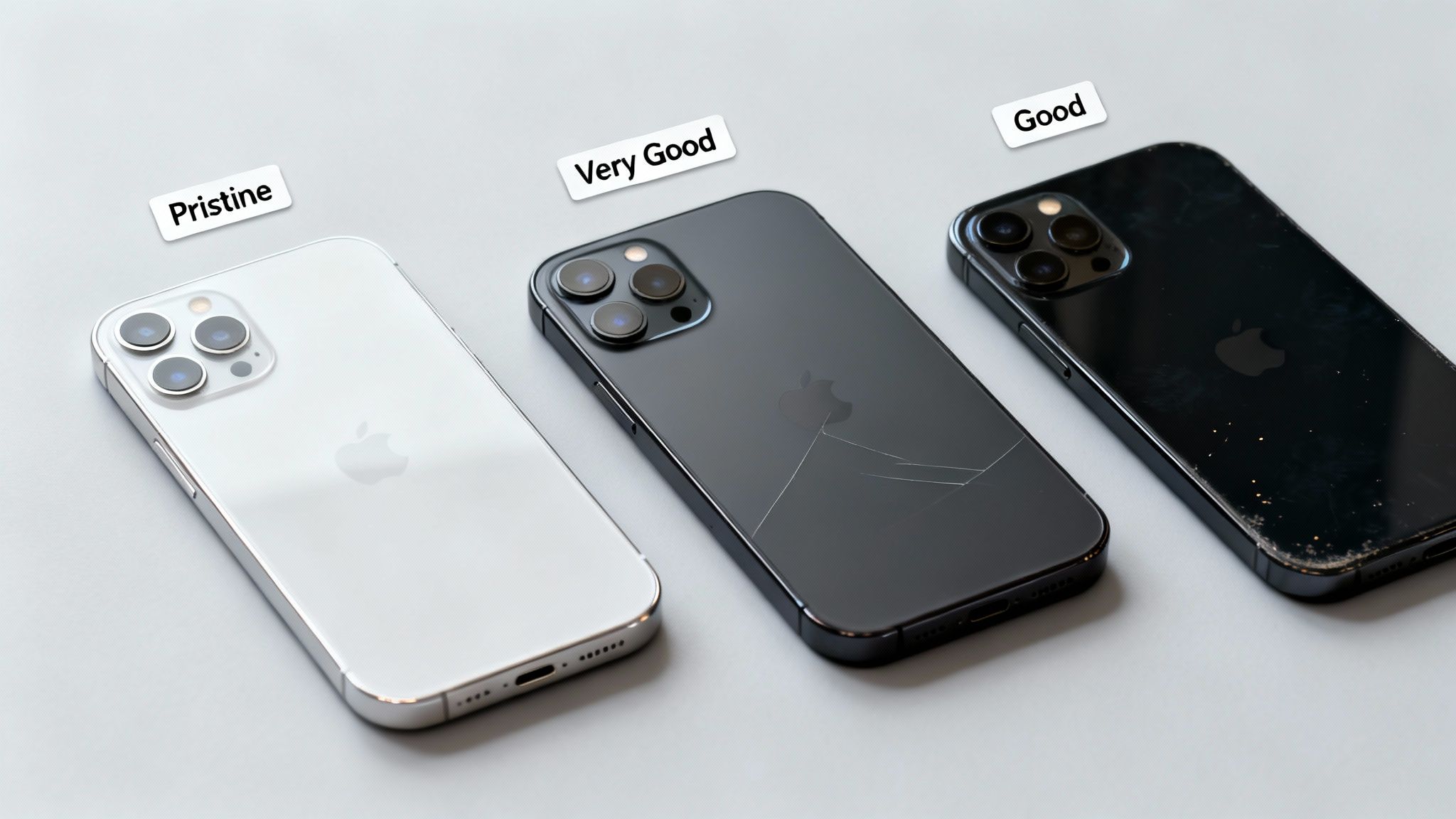
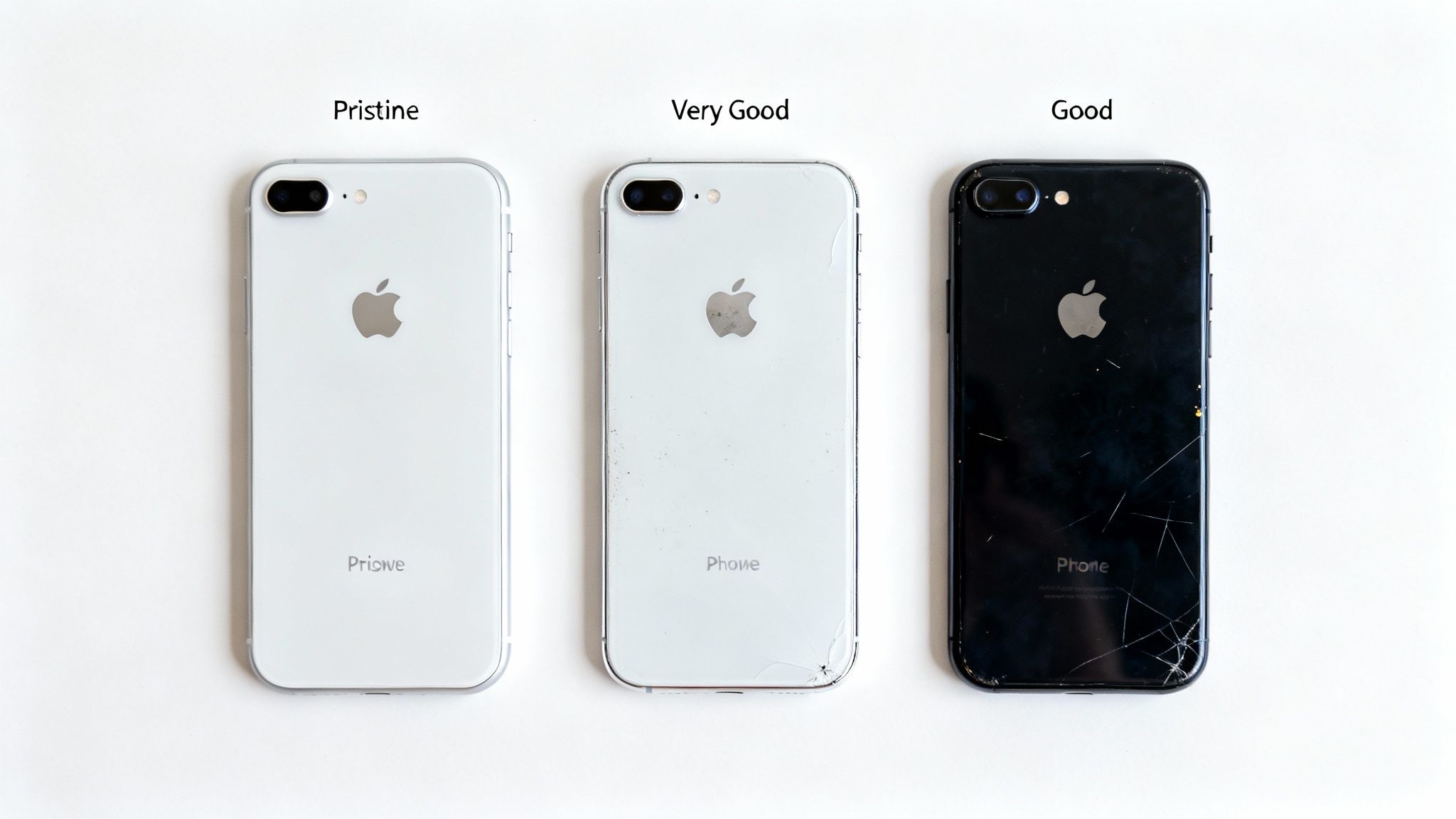
When you shop for a refurbished iPhone, you'll see terms like 'Pristine', 'Very Good', or 'Good'. These grades simply describe the phone's cosmetic condition.
The most important thing to remember is this: the grade has nothing to do with how the phone works. Every device, regardless of grade, has been through the exact same testing process and is 100% functional. The grade just gives you a heads-up on visual wear and tear, helping you decide what matters more—a flawless-looking mobile or a bigger saving.
What a Refurbished iPhone Means in the UK 29
A Breakdown of Common Grades
While the exact names might change a little between sellers, the levels of condition are generally the same. Getting your head around what each grade means will help you find the perfect balance between price and appearance.
Here’s what you can typically expect:
Pristine / Like New: This is the top tier. The iPhone will look practically brand new, with no visible scratches or scuffs on the screen or body.
Very Good / Excellent: This grade is fantastic value. The phone might have a few very faint micro-scratches on the screen or housing, but you'd have to look closely to spot them.
Good: A 'Good' grade iPhone will show more obvious signs of use, like small scratches or scuffs on the screen or body. Crucially, these are purely cosmetic and won't affect performance.
How to Choose the Right Grade for You
This choice comes down to personal preference. If you love that unblemished, straight-out-of-the-box feeling, then 'Pristine' is for you.
But if you plan to put a case and screen protector on your iPhone straight away, choosing a 'Good' condition device is a smart way to save more money. The minor marks will be hidden, and you get the exact same perfectly working phone for less. For a full deep-dive, check out our guide to refurbished phone grades.
The Real Benefits of Choosing a Refurbished iPhone
Saving money is probably the first thing that comes to mind with a refurbished iPhone, but the benefits go further than the price tag. It's a practical decision that delivers on cost, quality, and environmental responsibility.
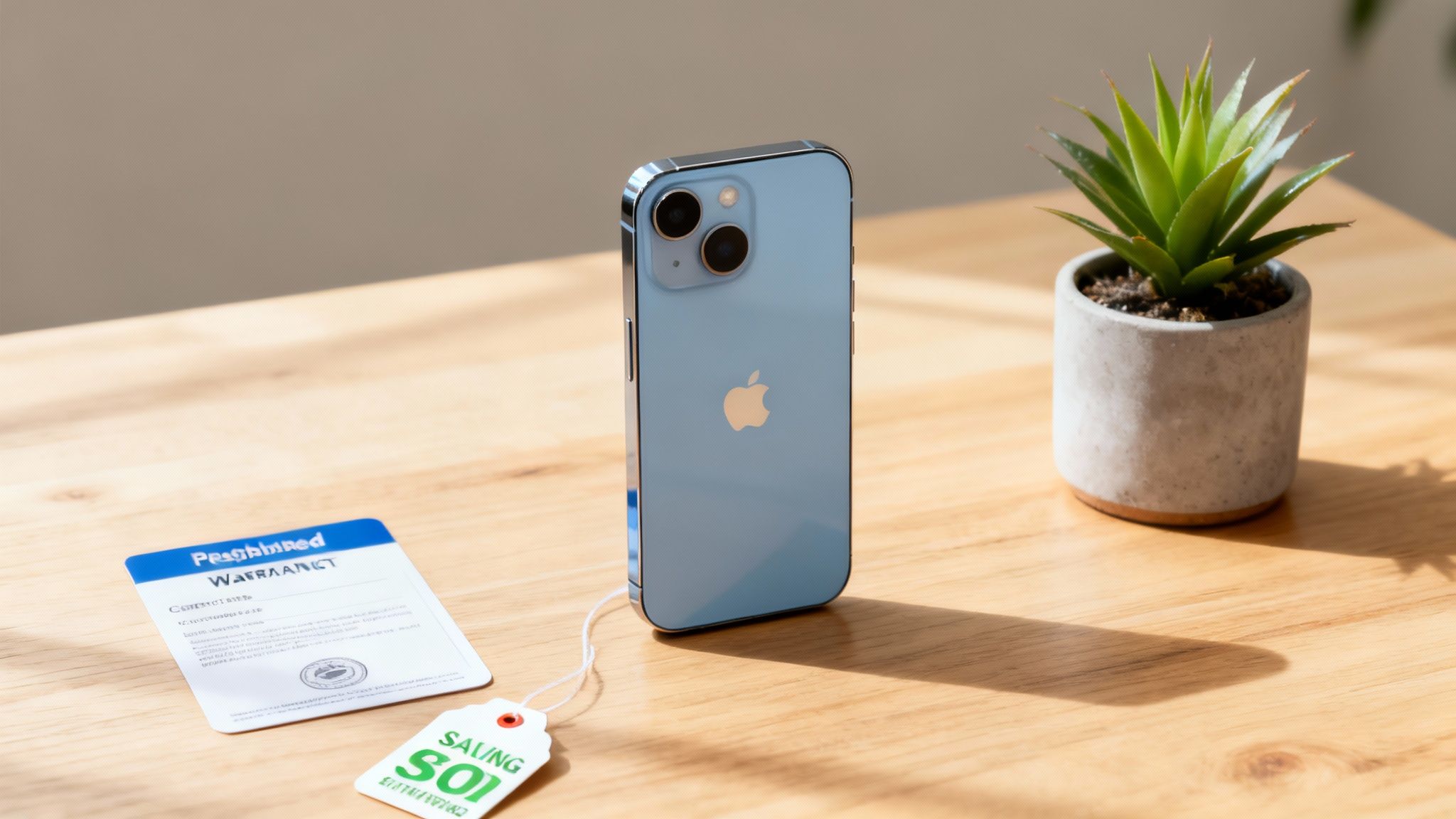
Beyond savings, what a refurbished iPhone means is you're getting security you simply don’t get with a typical second-hand sale. A device from a reputable retailer comes with two critical layers of protection.
Professional Testing: Every function has been checked and verified, from the battery health down to the responsiveness of the buttons. You know it works perfectly out of the box.
A Solid Warranty: You’re covered if an unexpected fault develops. That peace of mind is invaluable and a core part of the refurbished promise.
Opting for a refurbished iPhone is also a vote for sustainability. Every refurbished phone sold is one less device ending up in landfill, and it reduces the demand for the resource-intensive manufacturing of new ones. It’s a simple but effective way to lower your carbon footprint.
The UK's refurbished phone market has grown significantly, showing that more people are choosing this more sustainable option. You can find more insights on the UK’s used phone trends on Accio.
Ultimately, understanding what a refurbished iPhone means is realising it’s not just a budget option. It's a smart choice that balances affordability with guaranteed quality and environmental consciousness.
Your Checklist Before Buying a Refurbished iPhone
Knowing what the grades mean is a great start, but picking the right seller is just as important. A few minutes of homework now can save you headaches later.
Key Seller Checks
Before comparing models, take a look at the company you're thinking of buying from. Their policies tell you a lot about how much they stand behind their products.
Warranty Guarantee: Never settle for less than a 18 Month Warranty. A full year's guarantee is a sign of confidence in the testing and repair process.
Returns Policy: What if the phone arrives and it's not quite right? A clear, no-fuss returns policy is essential.
UK-Based Support: Check that the seller is based in the UK. If you need to ask a question or use your warranty, dealing with a local team makes life easier.
These three points are non-negotiable. If a seller doesn't offer all of them, it's best to walk away.
Essential Device Checks
Once you've found a seller you trust, zoom in on the phone itself. The critical details should be in the product description.
Unlocked for Any Network: Make sure the iPhone is listed as 'unlocked'. This means you can use a SIM card from any network provider—be it EE, O2, Vodafone, or Three—giving you the freedom to choose the best deal.
Battery Health Policy: A reputable seller will be upfront about battery health. Look for a guaranteed minimum capacity, usually 80% or higher. This is your assurance that the phone will hold a decent charge.
Activation Lock Status: This is critical. The phone must have its Activation Lock removed. A device with this lock still active is unusable. Make sure you know how to remove Activation Lock iPhone has been done properly before you buy.
Your refurbished iPhone has arrived. Getting it up and running is straightforward, but a few key steps will ensure everything goes smoothly.
First, insert your SIM card. Then, power the phone on, connect to a Wi-Fi network, and sign in with your Apple ID. This links the phone to your account for services like iCloud and the App Store.
Moving Your Data Across
If you're coming from an older iPhone, you'll want to bring your apps, photos, and settings with you.
Warning: Always create a fresh backup of your old mobile before starting a data transfer. If anything goes wrong during the process, this ensures all your important information is safe.
On your old iPhone, here’s how to create that backup:
Go to Settings > [your name] > iCloud.
Tap on iCloud Backup.
Make sure the toggle is on, then tap Back Up Now.
Once the backup is complete, you're ready to start the transfer. When you turn your new device on for the first time, Apple's Quick Start feature will pop up to guide you. For a complete walkthrough, our guide shows you how to transfer data to a new iPhone.
Finally, it’s a good idea to check for software updates. This makes sure your phone is secure and has the latest features. Just go to Settings > General > Software Update. If the steps look different on your phone, you can always check Apple's official support site for instructions specific to your iOS version.
Answering Your Questions About Refurbished iPhones
Here are answers to a few of the things our customers often ask when they're thinking about buying a refurbished iPhone.
Will My Refurbished iPhone Have a New Battery?
Not always, but it will always have a healthy one. Professional sellers guarantee a minimum battery health level, usually 80% or more of its original capacity.
If a phone's battery is below that threshold during testing, it will be replaced with a new one. It's always a good idea to check the seller's battery policy before you buy.
Is 'Refurbished' Just Another Word for 'Second-Hand'?
Not at all—they are very different. A phone listed as ‘second-hand’ or ‘used’ is usually sold privately by an individual. That means no professional checks, no guaranteed data wipe, and no warranty.
A refurbished iPhone, on the other hand, has been through a complete professional process. It's been tested, repaired, cleaned, and securely data-wiped by a specialist business. Most importantly, it comes with a warranty, making it a much safer and more reliable purchase.
Can I Use My Own SIM Card?
Yes. The vast majority of refurbished iPhones are sold ‘unlocked’. This means you can use a SIM card from any UK network you like, whether it’s O2, EE, Vodafone, or anyone else.
This gives you the freedom to find the best mobile plan for your needs. Still, it never hurts to double-check the product description to confirm the phone is listed as 'unlocked'.
What Accessories Come in the Box?
This can vary, so always check the product listing. To keep prices down and reduce electronic waste, most refurbished iPhones ship in a plain box with just a charging cable.
Headphones and a power adapter usually aren't included, as many of us already have them.
At Used Mobiles 4 U, every one of our devices comes with a free 18 Month Warranty and is guaranteed to have at least 80% battery health. Ready to find your perfect, reliable refurbished iPhone? Find your next iPhone today
Written by James Waterston — 24 years in the mobile phone industry from customer service to Sales Director of a global repair & recycling company; now running Used Mobiles 4 U for 8+ years. LinkedIn
This guide will help you find a reliable, sim-free refurbished iPhone for under £200. It explains what to look for, how to understand seller grades, and what checks to make before you buy, so you can get a great mobile for a fair price.
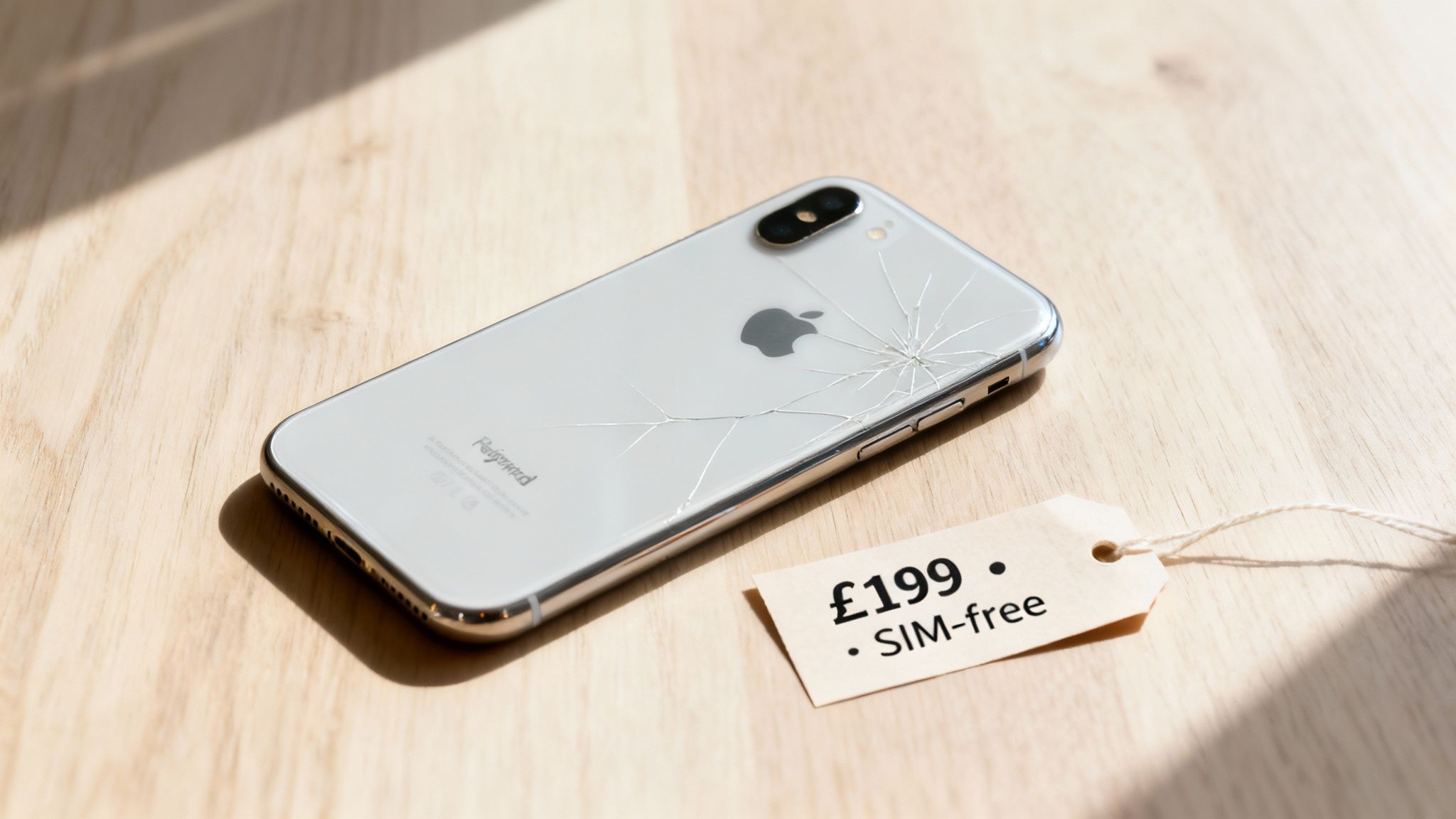
Finding a good quality, sim-free refurbished iPhone for under £200 in the UK is absolutely doable, and you’re not just stuck with older models either. You can often find popular workhorses like the iPhone SE (2020), the ever-reliable iPhone 8, and sometimes even a well-looked-after iPhone X in this price bracket.
What a £200 Budget Really Gets You in the Refurbished iPhone Market
Finding a Good Sim-Free Refurbished iPhone Under £200 in the UK 43
Buying a refurbished mobile isn't just a way to save cash; it’s a practical choice. You're giving a perfectly capable device a new lease of life, which is good for your wallet and helps to reduce e-waste.
The second-hand phone market is popular for this reason. You get a quality mobile without the high price tag, and we all contribute a little less to the growing amount of discarded electronics.
First, Let's Get the Lingo Right
Before we look at specific models, there are two key terms you'll see everywhere. Understanding these is the first step to finding the right mobile.
Refurbished: This isn't just a phone someone's pulled out of a drawer. A refurbished device has been professionally checked, tested, repaired if needed, and fully wiped of all previous data. Unlike a "used" phone from a private seller, a refurbished one comes from a professional seller and includes a warranty.
SIM-Free: This simply means the iPhone isn't tied to a particular network like EE, O2, or Vodafone. You can pop your own SIM card in—or find a new SIM-only deal—and it'll work straight away.
This combination of professional checks and network freedom makes finding sim free refurbished iphones under 200 pounds uk a great option for many people. It’s a good choice for a teenager's first mobile, a dependable backup for work, or for anyone who wants the Apple experience on a sensible budget.
In this price range, you’ll mainly find models that are a few years old but still perform well. They often still get the latest iOS updates from Apple and can handle everyday tasks like messaging, browsing, and social media without any issues.
Finding a Good Sim-Free Refurbished iPhone Under £200 in the UK 44
When you start shopping, you’ll see terms like 'Pristine,' 'Very Good,' and 'Good'. It helps to understand what these grades really mean, as they are almost entirely about the cosmetic condition of the phone, not how it works.
It’s important to remember this: no matter the grade, any phone from a reputable seller will be 100% functional. The grade just tells you what the phone looks like. A 'Good' grade iPhone will work just as well as a 'Pristine' one; it just has a few more signs of its previous life.
What Do the Grades Actually Mean?
While the names might differ slightly from seller to seller (some use A, B, C, for example), the standards are fairly consistent. Here’s a simple breakdown of what to expect from each grade.
Pristine (or Like New / Grade A): This is the top grade. The phone will look practically brand new, with no noticeable scratches or scuffs on the screen or body when held at arm's length.
Very Good (or Grade B): This is often a good balance of value and condition. A 'Very Good' iPhone might have some very light, minor signs of use, like faint scratches on the screen or small scuffs on the casing that are invisible when the screen is on.
Good (or Grade C): This grade offers the biggest savings. The phone will show moderate signs of wear and tear, like noticeable scratches on the screen and maybe a few scuffs or dings on the body. Crucially, none of these cosmetic marks will affect the phone's performance.
A Real-World Example
Let's imagine Alex needs a reliable mobile for their teenage son but doesn't want to spend a lot. They find two sim free refurbished iphones under 200 pounds uk—an iPhone SE (2020) graded 'Very Good' for £159, and the same model graded 'Good' for £139.
Alex knows his son will put the phone in a case straight away, so a few scratches on the back don't matter. By choosing the 'Good' grade, Alex saves £20 and gets a fully functional mobile that is perfect for his son's needs. The cosmetic marks are hidden by the case, and the phone works perfectly.
Getting your head around these grades is the key to finding the best value. For a deeper dive into how we assess these conditions, check out our complete guide to refurbished phone grading. It will give you the confidence to make a smart choice that fits your budget.
Your Essential Pre-Purchase Checklist
Before you click "buy", it's worth running through a few quick checks on the product listing. Getting these details right from the start can save disappointment later.
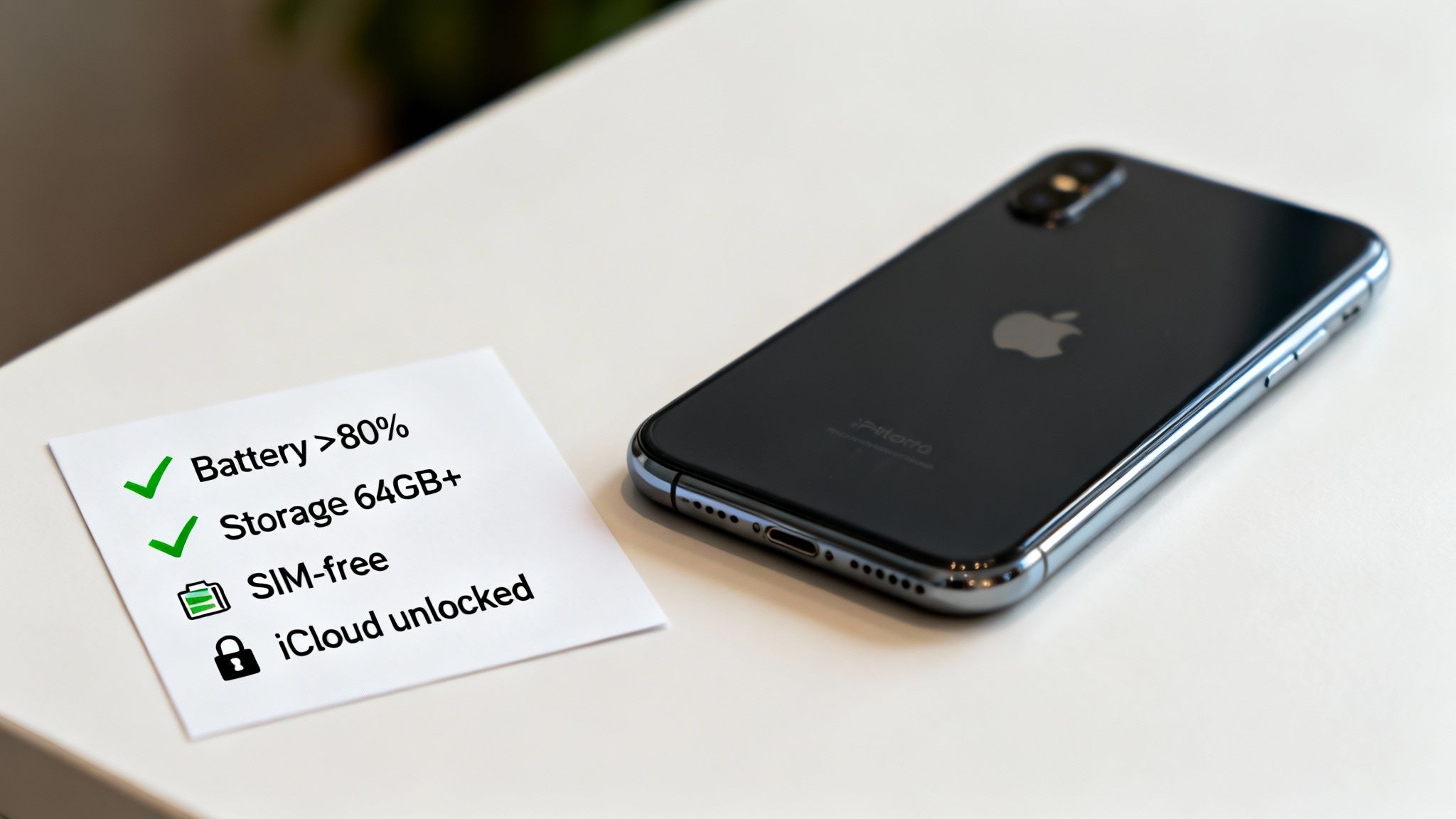
We’re going to look at four key areas: battery health, storage space, network status, and the iCloud lock.
Finding a Good Sim-Free Refurbished iPhone Under £200 in the UK 45
Check the Battery Health Guarantee
An iPhone's battery health dictates how long you can go between charges. All batteries degrade over time, but a good refurbished phone should still have plenty of life left.
Reputable sellers will state a minimum guaranteed battery capacity. Look for a promise of 80% or higher. Apple considers a battery to be at good performance above this threshold. Anything less and you might find yourself needing to charge it more often.
On an iPhone, you can check this yourself by going to Settings > Battery > Battery Health & Charging. The ‘Maximum Capacity’ figure tells you its health relative to when it was new. Of course, you can't check this before buying, so the seller's guarantee is your assurance.
Is the Storage Capacity Right for You?
When you’re hunting for sim free refurbished iphones under 200 pounds uk, the most common storage size you'll see is 64GB. For many people, that’s fine for day-to-day use.
But what really matters is how you use your mobile.
Light User: If you mainly use it for calls, texts, web browsing, and a few apps, 64GB is probably more than enough.
Heavy User: If you shoot high-res photos and videos, download lots of large apps and games, or save films, that 64GB can fill up fast. In that case, see if you can find a 128GB model.
Thinking about your needs now can prevent the "Storage Almost Full" notification later on.
Confirm It’s Genuinely SIM-Free and Unlocked
The term ‘SIM-free’ means the phone isn’t tied to a specific mobile network like EE, Vodafone, or O2. This gives you the freedom to use a SIM card from any provider, which is perfect for finding the best SIM-only deals.
Sometimes you'll see it described as ‘unlocked’, which means the same thing. Whatever the wording, double-check the product description to make sure.
The Most Important Check: iCloud Activation Lock
This is the single most critical check. The iCloud Activation Lock is Apple's anti-theft feature, linking an iPhone to the owner's Apple ID. If the previous owner hasn't properly removed their account, the phone is completely unusable for you.
Warning: A refurbished iPhone with an active iCloud Lock cannot be activated or used. There is no workaround. You must ensure the seller guarantees the device is free from any iCloud or Apple ID locks.
Any professional seller will have checks for this, ensuring every device is fully wiped and reset. Buying from a trusted business that specialises in refurbished iPhones practically eliminates this risk, as it's a standard part of their process.
Pre-Purchase Checklist for Your Refurbished iPhone
Ticking off these four points is your best bet for a smooth, hassle-free experience.
Why a Warranty Is a Non-Negotiable Safeguard
A low price is always tempting, but it’s what happens after you buy that matters. A solid warranty and a clear returns policy are essential protections when buying a refurbished mobile.
A warranty protects you against hardware faults that aren’t your fault. If the battery suddenly fails or the speakers stop working a few months later, a good warranty means you won’t be left out of pocket. It’s the seller’s promise that the device they’ve sold you is in good working order.
What a Good Warranty Should Cover
When you’re looking at sim free refurbished iphones under 200 pounds uk, a 18 Month Warranty should be your minimum expectation. This is the industry standard for any reputable UK seller.
A typical 18 Month Warranty will cover things like:
Hardware Failures: Problems with internal components like the logic board, speakers, microphones, or the charging port.
Battery Defects: If the battery’s health drops significantly below its guaranteed level due to a fault (not just normal ageing), it should be covered.
Software Glitches: Issues with the phone's operating system that aren't fixed by a standard reset.
It's also important to understand what isn't covered. Warranties almost never include accidental damage (like a cracked screen from a drop), water damage, or issues caused by unauthorised repairs. For more details, see our guide on what’s covered in a refurbished phone warranty.
Understanding Your Return Rights
Alongside a warranty, a clear returns policy is crucial. This covers you if the phone isn't what you expected when it arrives. Always look for sellers offering at least a 14-day return period, a legal requirement for online sales in the UK. Many sellers extend this to 30 days.
This gives you a chance to hold the mobile, test its features, and make sure you’re happy with its condition. If you’re not satisfied for any reason, you can send it back for a full refund.
A strong warranty and a fair returns policy are the biggest advantages of buying from a professional refurbisher instead of a private seller.
How to Choose a Trustworthy UK Seller
Finding a Good Sim-Free Refurbished iPhone Under £200 in the UK 46
Finding the right phone is only half the task. Picking the right seller is what really guarantees a good experience.
With so many options online, it’s important to know what to look for. This will help you spot the signs of a reliable UK-based seller, from their grading and warranties to their customer support.
Key Trust Signals to Look For
When you're browsing, certain things on a seller’s website should give you immediate confidence. These are clear signs of a professional and customer-focused business.
Keep an eye out for these essential trust signals:
UK-Based Operations: A clear UK address and phone number mean you’re dealing with a local business that operates under UK consumer law. It makes communication and any returns much simpler.
Transparent Grading System: A trustworthy seller will have a dedicated page clearly explaining their grading criteria, so you know exactly what to expect.
12-Month Warranty as Standard: A full year’s warranty shows the seller is confident in the quality of their refurbishment process.
Clear Returns Policy: Look for a minimum 14-day returns policy. This gives you time to properly check the device.
Positive Independent Reviews: Check reviews on platforms like Trustpilot or Google. Honest feedback from previous customers is one of the most reliable indicators of a seller's reputation.
Specialist Retailer vs Private Marketplace Seller
You might see what looks like a bargain on a site like Facebook Marketplace or Gumtree. While the price can be tempting, buying from a private individual carries risks that you don't face with a specialist refurbished phone business. The biggest difference comes down to accountability and expertise.
Think about the benefits of choosing a specialist business:
Data Security: A professional refurbisher uses certified software to securely wipe all data from a device. A private seller might just do a basic factory reset, which isn't always enough to permanently erase information. Our guide on how to factory reset an iPhone explains why this is so important.
Thorough Testing: Specialists conduct multi-point diagnostic checks on every device. A private seller can only tell you if it "worked fine" for them.
After-Sales Support: If you have an issue with a phone bought from a specialist, you have a warranty and a customer service team to turn to. With a private sale, you are usually on your own.
No Hidden Locks: A professional seller guarantees the phone is unlocked and free from any iCloud Activation Lock, a common issue when buying from private sellers.
By opting for a reputable business, you're investing in reliability and peace of mind. You get a fully tested device, a solid warranty, and the assurance that your purchase is protected by UK consumer rights.
Getting Your New Refurbished iPhone Set Up
Once your refurbished iPhone arrives, you’ll be up and running in just a few minutes. We'll walk you through the first simple steps, from inserting your SIM card to moving your data across from your old mobile.
First Steps Out of the Box
Before you turn the phone on, find the SIM tray on the side of the iPhone. Use the small SIM ejector tool (or a straightened paperclip) to pop the tray open. Place your SIM card inside and slide it back in.
With a sim-free refurbished iPhone, you're not tied to any network. This can be useful if you need to find the cheapest way to call internationally. Once the SIM is in, press and hold the side button to power up your iPhone.
The phone will boot up and an on-screen setup assistant will take you through the rest:
Choose your language and country.
Connect to a Wi-Fi network.
Set up Face ID or Touch ID.
Create a passcode.
Moving Your Data Across
Bringing over your contacts, photos, and apps from your old device is an important step. Before you start, it’s a good idea to make sure your old phone is fully backed up.
Warning: To avoid losing your personal information, always create a fresh backup of your old phone before you begin the transfer. You can do this by going to Settings > [your name] > iCloud > iCloud Backup and tapping Back Up Now.
During the setup process on your new iPhone, you’ll get to a screen called 'Apps & Data'. If you're coming from another iPhone, the 'Quick Start' feature is the easiest way. Just bring your old iPhone close to the new one, and it’ll guide you through the transfer.
For a more detailed look at all the options, our guide explains how to move everything from an old iPhone to a new one.
Got Questions? We’ve Got Answers
Thinking about buying a refurbished iPhone for under £200? It's a practical move, but you may have a few questions. Let's cover some of the most common ones.
What’s a Realistic Battery Life for a Refurbished iPhone Under £200?
Any reputable seller should guarantee a minimum battery health, usually 80% or higher. For models in this price range, like the iPhone 8 or SE (2020), that’s enough to get you through a full day of typical use. It will have been tested to make sure it holds a reliable charge.
Does SIM-Free Mean I Can Use the Phone Abroad?
Yes. 'SIM-free' means the iPhone isn't tied to a specific UK network. You can pop in a SIM card from any UK provider, and it’ll work straight away. This is also a bonus for travelling. When you arrive at your destination, you can buy a local SIM card and slot it into your phone to avoid high roaming charges.
Will My Refurbished iPhone Look Brand New?
This all comes down to the grade you choose. A top-tier ‘Pristine’ grade will look almost perfect. Realistically, in this price range, you’ll be looking at phones in ‘Very Good’ or ‘Good’ condition, which are fully functional but will show some light signs of use.
Very Good: Might have a few faint, light scratches on the screen or body.
Good: Will have more obvious signs of wear, like noticeable scratches or small scuffs.
A good seller will always give you a clear and honest description of what to expect.
Is Buying Refurbished Really Better for the Environment?
Yes, it makes a significant difference. Manufacturing a new smartphone is an intensive process that uses a large amount of energy and raw materials. By choosing a refurbished mobile, you’re giving a perfectly good device a second life. This directly reduces e-waste and lowers the carbon footprint associated with making a brand-new phone.
Written by James Waterston — 24 years in the mobile phone industry from customer service to Sales Director of a global repair & recycling company; now running Used Mobiles 4 U for 8+ years. LinkedIn
Thinking about getting a new phone but wincing at the price? You’re not the only one. Buying used phones in the UK is a super smart move that gets you a brilliant gadget without making your piggy bank cry. Think of it like buying a fantastic, second-hand car that a trusted mechanic has checked from top to bottom; you get all the good stuff for a much friendlier price.
Why a Used Phone is a Smart Choice
Choosing used phones in the UK or pre-loved phone is getting more and more popular, and for good reason. It’s one of the cleverest ways to get your hands on the phone you really want—like a newer iPhone or Samsung—without the scary price of a brand-new one. We’re talking about saving hundreds of pounds.
But it’s not just about saving pocket money. It’s also a brilliant choice for the planet. Every time someone picks a used phone, that’s one less phone heading for a rubbish dump. This simple choice helps cut down on electronic waste, which is a huge and growing problem all over the world.
What is the Difference Between Used Phones in the UK and Refurbished?
You’ll often see the words ‘used phones in the UK’ and ‘refurbished’ about, and while they sound similar, there’s a really important difference you need to know.
Used Phone: This is usually a phone sold just as it is, maybe by a person online. It works, but it hasn’t been properly checked, cleaned, or fixed by an expert. It’s a bit of a gamble.
Refurbished Phone: This is where the magic happens. A refurbished phone is a used phone that has been sent to experts for a full check-up. They test everything—the battery, screen, buttons, and cameras—and fix or replace anything that isn’t perfect. It’s then cleaned up and made ready for a new owner, often feeling almost like new.
To be sure you’re getting a great phone, choosing a refurbished one from a trusted seller is always the safest bet. It means you can be sure your “new” phone will work perfectly as soon as you open the box. To get a better feel for this, you can learn more about the rise of second-hand phones in the UK.
A refurbished phone is the best of both worlds. You get the huge savings of buying used, but with the confidence that it has been properly tested and comes with a guarantee. It’s the clever way to upgrade.
This isn’t just happening here; it’s a worldwide thing. The market for refurbished and used mobile phones is already massive and is set to grow from around $73.1 billion to over $120.6 billion by 2032. Here in the UK, this is happening because people are making choices that are better for the planet and new “right to repair” rules encourage us to fix things instead of just binning them. You can explore more on these mobile phone market trends to see just how big this has become.
Understanding What Phone Grades Mean
When you start looking for used phones in the UK, you’ll quickly see words like ‘Pristine’, ‘Very Good’, or ‘Good’. At first, this might seem a bit confusing, but it’s actually a really simple system to show you exactly what the phone you’re buying is like.
Think of it as a report card for how the phone looks. Each grade tells you about its condition on the outside. This is great because it means there are no nasty surprises when your phone arrives in the post.
A phone with a top grade like ‘Pristine’ (sometimes called Grade A) will look and feel almost brand new. A ‘Good’ (or Grade C) phone will work perfectly but might have a few scuffs or scratches from its previous owner. The most important thing to remember is that all grades are just about how the phone looks; the inside parts have been fully tested and work perfectly, no matter the grade.
Decoding the Different Phone Grades
So, what does each grade really mean? While the names might be slightly different depending on the seller, they all work in the same way. Let’s break down the most common grades you’ll see.
Pristine (or Grade A): This is the best of the best. A Pristine phone is in amazing condition and shows almost no signs of being used. You’d have to look very closely to find any mark at all. It’s the perfect choice if you want that “new phone” feeling without the new phone price.
Very Good (or Grade B): This is a fantastic choice in the middle and is often the most popular. A ‘Very Good’ phone might have a few tiny, light scratches, but you would hardly notice them. It’s a great way to save a bit more money while still getting a phone that looks brilliant.
Good (or Grade C): This grade will save you the most money. A ‘Good’ condition phone will have more obvious signs of use, like scratches you can see on the screen or marks on the body. But, none of these will affect how the phone works at all. It’s perfect if you don’t mind a few battle scars and want the best possible price.
Getting to know these grades is the secret to making a smart purchase. For a more detailed look, you can check out our complete guide to refurbished phone grades, which explains even more.
Which Grade is Right for You?
Choosing the right grade is all about what’s more important to you: saving money or having a phone that looks perfect.
If you plan on putting a case and screen protector on your phone straight away, you might not even notice the scratches on a ‘Good’ condition phone. This simple choice could save you a lot of money.
But if having a phone that looks spotless is important to you, paying a little bit extra for a ‘Pristine’ one is well worth it. You still get a huge discount compared to buying new, but with a phone that looks perfect.
Remember, how well the phone works isn’t linked to its grade. A Grade C phone has passed the same tough tests as a Grade A one. The only difference is how it looks on the outside.
To make it even clearer, here’s a simple table to help you decide.
A Simple Guide to Refurbished Phone Grades
This table explains the common grades so you know exactly what your used phone will look like.
This grading system puts you in charge, letting you pick the perfect phone for you and your piggy bank.
Where to Safely Find Used Phones in the UK
A Guide to Used Phones in the UK 56
So, you know what the phone grades mean, but where do you actually start looking? Finding a trustworthy place to buy used phones in the UK is the most important part of your adventure. It’s a bit like choosing a good garage for your car; you need someone you can trust to give you something that’s safe and works well.
The good news is there are lots of brilliant, totally safe places to buy from. The trick is to avoid dodgy sellers on random websites where you have no protection. Instead, you’ll want to stick with proper, well-known companies. These businesses have a reputation to look after, so they work hard to check every phone and make sure you’re happy.
Let’s look at some of the best and safest places to find your next phone.
Certified Shops and Websites
These are websites that are experts in selling refurbished gadgets, and honestly, they’re a fantastic place to start. They live and breathe used phones, which means they have expert teams who test every single device before it goes on sale.
Think of them as huge, reliable second-hand shops just for gadgets. You get an amazing amount of choice, good prices, and, most importantly, you know you’re safe.
Here are a few popular choices in the UK:
MusicMagpie: One of the biggest names out there, offering a massive range of phones. They give you a free 18 Month Warranty on all their tech, which gives you confidence that you’re covered.
Giffgaff: Best known for its mobile network, Giffgaff also sells a great selection of refurbished phones. They often give warranties of up to 24 months on some phones—which is amazing for a used device.
Envirofone: Another expert that puts its phones through a 100-point quality check before selling them. This detailed check makes sure everything from the battery to the camera is working perfectly.
When you buy from places like these, you’re not just getting a phone; you’re getting a promise that it’s been properly looked after.
Official Programmes from Phone Makers
Did you know that some of the biggest phone makers sell their own refurbished models? Going directly to companies like Apple or Samsung is one of the safest things you can do. The phones might be a little more expensive than from other sellers, but the quality is absolutely top-notch.
When a phone maker refurbishes a phone, they use their own official parts and expert helpers. It’s the closest you can get to buying a brand-new phone without the brand-new price.
Apple Certified Refurbished: This is the best you can get for used iPhones. Every single phone gets a brand-new battery and outer case, is put in a new box with all the right bits and bobs, and comes with a full one-year Apple warranty.
Samsung also has its own ‘Re-Newed’ programme, offering phones that are fixed up to factory standards and come with a warranty. If you love a certain brand, this is an excellent and incredibly safe option. It gives you the best guarantee that your phone has been perfectly restored by the people who made it.
Mobile Network Providers
Your own mobile network, whether it’s O2, Vodafone, or EE, is another great place to look. Many of the big UK networks now sell refurbished phones. This can be a really handy option, especially if you’re also looking for a new SIM-only plan.
The good things about this are pretty clear:
Trust: You’re buying from a huge, well-known company you already know.
Quality Checks: They all have strict tests to make sure every phone is in great working condition.
Warranties: Just like other sellers, they give you a warranty to protect you.
For example, O2’s ‘Like New’ phones come with a 18 Month Warranty and have passed lots of tough quality checks. Buying from your network can feel familiar and safe, making it a solid choice for anyone feeling a bit nervous about buying a used phone for the first time. For more ideas on where to shop, check out our guide on the best used phones in the UK and the top places to find them.
Your Smart Buyer Checklist
You’ve found a phone you like, and you’re almost ready to buy. But before you do, let’s run through a quick checklist. Think of this as your secret weapon for making sure you’re getting a brilliant deal on a phone that will last.
Going through these simple checks will make you feel sure about your purchase. It helps you avoid any nasty surprises and makes sure the phone you get is exactly what you hoped for.
Check the Warranty First
This is the most important check of all. A warranty is basically the seller’s promise to you that the phone works perfectly. If anything goes wrong that isn’t your fault, they will fix it, replace it, or give you your money back.
Never, ever buy a used phone without at least a 18 Month Warranty. This shows the seller is sure about the quality of their phones. It’s your safety net and the number one sign of a trustworthy place to buy used phones in the UK.
Understand the Return Policy
What if the phone arrives and it’s not quite what you expected? That’s what the return policy is for. Good sellers will always give you a ‘cooling-off’ period, usually between 14 and 30 days, to try out the phone.
During this time, you can test everything and make sure you’re completely happy. If you’re not, you can send it back for a full refund, no questions asked. Always check the seller’s website for their return policy before you buy.
A good warranty and a clear return policy are things you must have. They protect you from any problems and show that the seller is a proper, trustworthy business that cares about its customers.
Ask About Battery Health
A phone’s battery is like the engine in a car; it needs to be in good shape. Over time, all batteries lose a bit of their power. A phone’s ‘battery health’ is shown as a percentage, which tells you how much life it has left compared to when it was brand new.
For a used phone, you should look for a battery health of 80% or higher. Any less than that, and you might find you need to charge it more often than you’d like.
What to do:
Look in the description: Good sellers will often say what the minimum battery health is in the phone’s description.
Ask the seller: If you can’t see it, don’t be shy! Send them a quick message to ask what the battery health is.
This is a really important step. After all, you want a phone that can keep up with you all day long! Worries about battery life and warranty are common, but luckily, things have got much better. Big brands like Apple and Samsung now have proper refurbishment programmes that promise quality, building more trust in the second-hand market.
Confirm What Is in the Box
Finally, check what comes with the phone. A brand-new phone always comes with a charging cable, but that’s not always the case with a used one.
Most professional sellers will include a charging cable, but it’s always best to double-check. The product description should say everything that’s included in the box. This simple check stops you from being disappointed when your new phone arrives without a way to charge it.
How Trading In Your Old Phone Works
A Guide to Used Phones in the UK 57
Got an old phone gathering dust in a drawer? Don’t let it sit there. Trading it in is a brilliant way to get a good amount of money off the price of your next phone. It’s a bit like swapping your old toys at a shop to get money off a new one.
The whole thing is much simpler than you might think. You can turn that old gadget into cash or credit towards a shiny, refurbished phone. Plus, you’ll be doing something great for the planet by giving your old phone a new life.
Getting a Price for Your Old Device
First things first: you need to find out what your old phone is actually worth. Most websites that sell used phones in the UK have a trade-in part. All you have to do is answer a few simple questions about your phone.
These questions are usually pretty easy:
What make and model is it (for example, Apple iPhone 11)?
How much storage does it have (for example, 64GB)?
What condition is it in (does it turn on, is the screen cracked)?
Just be honest about its condition to get the right price. Once you’ve filled in the details, you’ll get a price straight away. This is how much the company will give you for your phone. If you’re happy with the offer, you can accept it and move on to the next step.
Trading in is a huge chance that lots of people miss out on. In fact, only about 31% of people in Europe trade in their old phones, which means millions of phones that could be used again are just left sitting in drawers.
Preparing Your Phone for Its New Home
Before you send your phone away, you need to get it ready. This is a super important step to protect your private information. Think of it like clearing out your locker at the end of the school year—you don’t want to leave any of your secret stuff behind for the next person.
You’ll need to completely wipe all your data from the phone. This means deleting all your photos, messages, apps, and accounts. A simple factory reset will do the job, putting the phone back to how it was when it was new.
This makes sure none of your personal information ends up in the wrong hands. It’s a simple thing to do, but it’s very important for your privacy and safety. For a step-by-step guide, check out our page on how to wipe your data before trading your old phone in.
Posting Your Phone Safely
Once your phone is wiped clean and ready to go, it’s time to send it off. The trade-in company will usually send you a free postage pack. This pack will have everything you need, including a padded envelope and a pre-paid postage label.
All you have to do is pop your phone into the packaging and drop it off at the Post Office. It’s completely free and insured, so you don’t have to worry about it getting lost or damaged on its way.
When the company gets your phone, they’ll give it a quick check to make sure its condition is the same as you told them. If everything looks good, they’ll pay you the money or give you the credit towards your next purchase. It really is an easy and great way to upgrade your tech.
So, you’ve got all the info you need to find a fantastic deal on a used phone. Let’s be honest, getting a pre-loved phone is a brilliant move. It’s a win for your wallet, a win for the planet, and you still get an amazing gadget.
By now, you should feel ready to shop with total confidence. You know what the grades mean, you know where to find trustworthy sellers, and you know exactly what to look for before you buy. Just remember, a good warranty and a clear returns policy are your best friends here—they’re your safety nets.
Your Final Pre-Flight Checklist
To make things even simpler, let’s do a quick recap of the really important stuff. Think of this as your final check before you go out there and find your perfect phone.
Always Get a Warranty: You must have this. Look for at least a 18 Month Warranty, as it’s the clearest sign of a seller who trusts their products.
Check the Battery Health: Look for phones with 80% or more battery life left. Any less and you might struggle to get through the day on one charge.
Know the Returns Policy: Make sure you have at least 14 days to properly test the phone. If it’s not what you expected, you need an easy way to send it back.
It’s amazing how many phones are around in the UK. At the start of 2025, there were a whopping 88.4 million mobile connections—that’s more phones than people! This is because so many of us upgrade regularly, which creates a huge supply of top-quality used phones just waiting for a new home.
Choosing used phones in the UK is one of the easiest ways to make a smart, planet-friendly choice. You’re saving a perfectly good gadget from becoming waste, meaning fewer new ones need to be made, and you’re saving yourself a lot of money.
You’re not just buying a phone; you’re making a clever choice that you can feel really good about. You are now fully ready to find, check, and buy one of the best used phones in the UK. Happy shopping!
Your Questions About Used Phones Answered
A Guide to Used Phones in the UK 58
Still got a few questions buzzing around in your head? You’re definitely not the only one. It’s always smart to get all the facts straight before you buy something as important as a phone.
This section is here to give you clear, simple answers to the most common questions people have about buying used phones in the UK. Think of it as the final piece of the puzzle, giving you that last bit of confidence before you find your perfect phone.
Is It Safe to Buy Used Phones Online in the UK?
Yes, it is completely safe, as long as you buy from a proper seller. The trick is to stick with well-known websites that are experts in refurbished phones, the official refurbished shops of brands like Apple, or big mobile network providers.
These places check every single phone from top to bottom. They also give you a warranty and a good returns policy, which means you’re protected if anything goes wrong.
Will the Battery on a Used Phone Be Any Good?
This is a brilliant question, and it’s something lots of people worry about. Good sellers always test the battery health and will often put a brand-new one in if the old one isn’t good enough.
They nearly always promise a certain battery health level, usually 80% or higher. Just make sure to check the product description for this information before you buy. This makes sure you get a phone that can easily last you the whole day.
What Is the Difference Between Refurbished and Used?
It’s easy to get these two mixed up, but they’re really quite different. Imagine you’re buying a second-hand bike.
A ‘used’ bike might be sold by someone down the street. It works, sure, but it hasn’t been checked over by an expert.
A ‘refurbished’ bike has been taken to a proper bike shop, where an expert has checked the brakes, fixed the gears, and polished it all up.
A refurbished phone has been professionally tested, cleaned, and repaired if needed. Most importantly, it also comes with a warranty, which makes it a much safer and more reliable choice.
Can I Return a Used Phone If I Don’t Like It?
Yes, definitely! This is another big reason why it’s so important to buy from a proper shop. Every trustworthy seller in the UK must give you a returns policy, which usually gives you between 14 and 30 days.
This is your ‘cooling-off’ period. It gives you plenty of time to really use the phone and make sure you’re completely happy with it. Always have a quick look at the seller’s returns policy before you click that buy button.
Order Today
By continuing to browse our site, you agree to the use of our cookies.
This website uses cookies to improve your experience while you navigate through the website. Out of these, the cookies that are categorized as necessary are stored on your browser as they are essential for the working of basic functionalities of the website. We also use third-party cookies that help us analyze and understand how you use this website. These cookies will be stored in your browser only with your consent. You also have the option to opt-out of these cookies. But opting out of some of these cookies may affect your browsing experience.
Necessary cookies are absolutely essential for the website to function properly. These cookies ensure basic functionalities and security features of the website, anonymously.
Cookie
Duration
Description
cookielawinfo-checkbox-analytics
11 months
This cookie is set by GDPR Cookie Consent plugin. The cookie is used to store the user consent for the cookies in the category "Analytics".
cookielawinfo-checkbox-functional
11 months
The cookie is set by GDPR cookie consent to record the user consent for the cookies in the category "Functional".
cookielawinfo-checkbox-necessary
11 months
This cookie is set by GDPR Cookie Consent plugin. The cookies is used to store the user consent for the cookies in the category "Necessary".
cookielawinfo-checkbox-others
11 months
This cookie is set by GDPR Cookie Consent plugin. The cookie is used to store the user consent for the cookies in the category "Other.
cookielawinfo-checkbox-performance
11 months
This cookie is set by GDPR Cookie Consent plugin. The cookie is used to store the user consent for the cookies in the category "Performance".
viewed_cookie_policy
11 months
The cookie is set by the GDPR Cookie Consent plugin and is used to store whether or not user has consented to the use of cookies. It does not store any personal data.
Functional cookies help to perform certain functionalities like sharing the content of the website on social media platforms, collect feedbacks, and other third-party features.
Performance cookies are used to understand and analyze the key performance indexes of the website which helps in delivering a better user experience for the visitors.
Analytical cookies are used to understand how visitors interact with the website. These cookies help provide information on metrics the number of visitors, bounce rate, traffic source, etc.
Advertisement cookies are used to provide visitors with relevant ads and marketing campaigns. These cookies track visitors across websites and collect information to provide customized ads.