


Screen Protector Types Explained and Which to Choose

30/07/2026

10 Mins

Meta description: Screen protector types explained for UK buyers, with clear advice on tempered glass, PET, hydrogel, privacy, matte and blue light options for real use.
Screen protector types are mostly about tempered glass, and 61% material share in one 2026 report still makes that the sensible default for most UK buyers, with full-coverage tempered glass even higher at 72% in that niche segment (Persistence Market Research). If you want the short answer, start with a good 9H tempered glass protector, then only move away from it if your screen shape, case fit, or fingerprint sensor makes that choice awkward.
What Most UK Buyers Should Pick Right Now
A decent tempered glass protector is still the first thing I'd hand many people buying a refurbished or used phone. It feels closest to the bare screen, gives the best everyday clarity, and fits the way many customers use their phones, which is pocket, bag, desk, car, repeat. If the phone has a flat display and a normal case, glass is usually the least annoying option.
Practical rule: choose glass first, then check whether your phone has a curved screen, an ultrasonic fingerprint sensor, or a very tight case.
Before you buy, look at four things.
- Screen shape: flat screens suit rigid glass best. Curved edge displays often push buyers towards flexible film or hydrogel, because rigid glass can lift at the edges.
- Fingerprint sensor: thicker glass can get in the way of ultrasonic sensors, so thinner profiles are the safer engineering choice when biometrics matter.
- Case fit: a protector that fights your case is a bad buy, even if the packaging screams premium.
- Daily use: commuters, school runs, site work, desk use, and gaming all push you towards different trade-offs.
The shape of the market backs that up. Protectors have shifted towards curved-edge formats, with one study putting 2.5D products at 52% of revenue and saying 3D protectors are growing fastest (Market.us). That tracks with what we see on modern Samsung and Android handsets, where edge curvature is common and buyers want the screen fully covered without a fight.
If you only remember one thing, make it this. Buy for fit first, protection second, and marketing last. The better the protector matches the phone, the less likely it is to lift, bubble, or interfere with the case.
Tempered Glass, PET and Hydrogel Compared
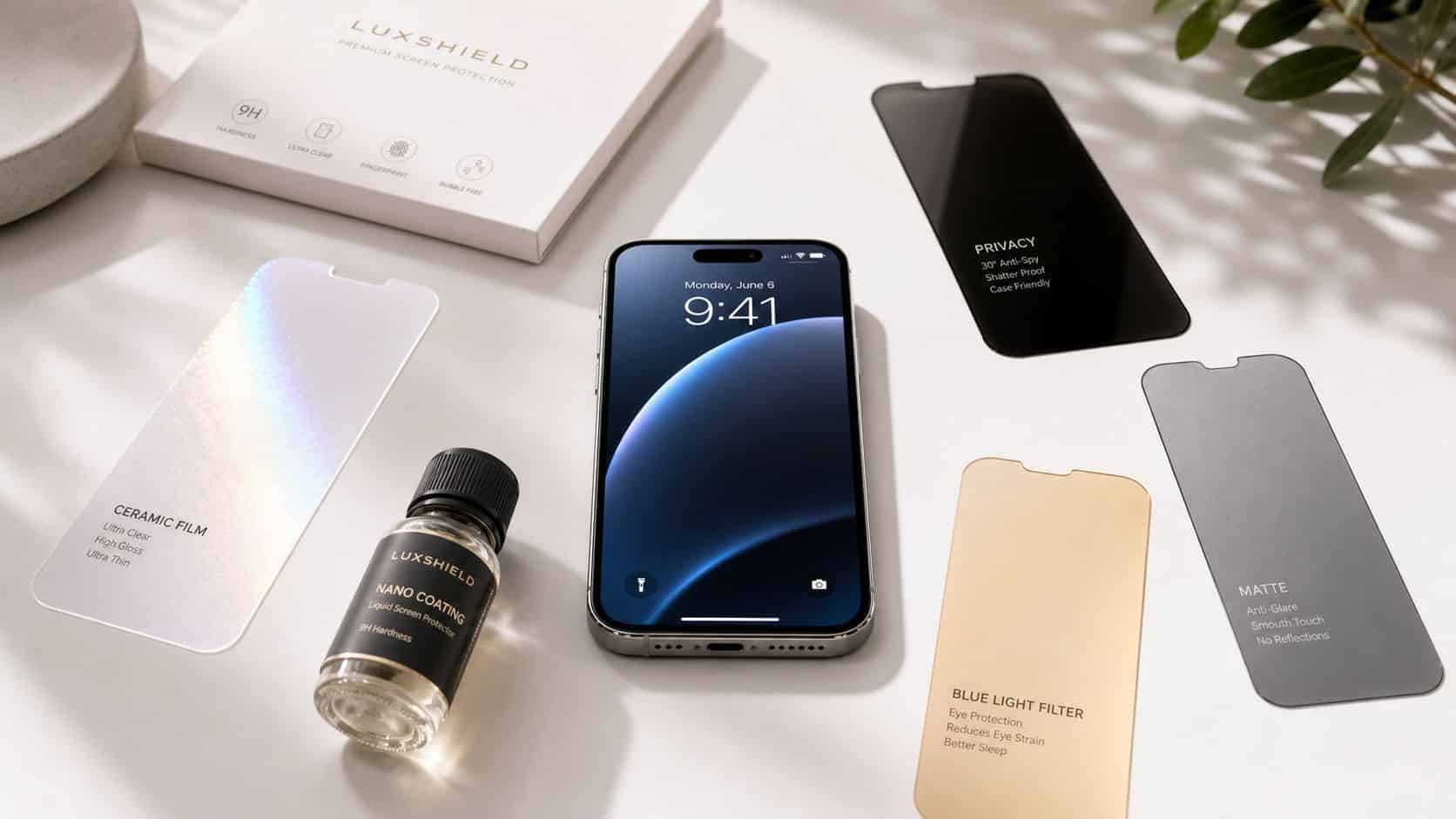
Tempered glass is the mainstream choice because it feels right. It's usually built around 0.25 to 0.33 mm thick, which is thin enough to keep the touch response close to native while still adding proper scratch and impact resistance (Alibaba buying guide). The better versions also give excellent clarity and a smoother glide under the thumb than plastic film (iThat).
PET is the cheap film option. It's much thinner, usually around 0.10 to 0.25 mm, and that thinness is why it can sit neatly under tight cases or on awkward edges (Belkin). The problem is simple, it gives the least scratch and impact protection, even if it's light, cheap, and hardly visible once fitted (PCMag).
TPU hydrogel sits in the middle. It's flexible, elastic, and more forgiving on curved displays, and it improved on PET by adding better impact absorption and the ability to recover from minor marks over time (Mous). That self-healing behaviour is real, but only for light surface marks, not a hard drop onto paving.
A lot of customers ask why glass still wins if film can wrap edges better. The honest answer is that glass gives you the best everyday feel and the best optical clarity, while film and hydrogel win on conformity. On our refurb bench, the failures we see are usually not because the protector was “bad”, but because it didn't match the case, or the phone's curve, or the sensor underneath.
If you want a broader consumer view before choosing between a rigid and flexible option, the hydrogel or tempered glass screen protector comparison is useful for understanding the trade-off in plain language. For people trying to deal with light surface wear rather than full replacement, this budget-friendly screen scratch fix advice also helps put expectations in the right place.
For most buyers, the decision is straightforward.
- Choose tempered glass if: you want the best feel, the clearest screen, and proper all-round everyday protection.
- Choose PET if: you mainly want a thin, cheap barrier and don't mind weak impact protection.
- Choose TPU hydrogel if: you've got a curved display, a tight case, or you need flexibility more than hardness.
Ceramic, Liquid, Privacy, Matte and Blue Light Options
Specialty screen protector types make sense when the problem isn't just “keep it safe”. Some people want privacy on a train, some want less glare outside, and some just want a surface that behaves better in bright offices or at night. Those are real use cases, but each option comes with a trade-off that people tend to discover after fitting it.
Ceramic-style protectors are the one specialist option I'd take seriously if someone wants a tougher film with a more glass-like feel. They're pitched as scratch-resistant and close to tempered glass in hand feel, although the practical value still depends on the phone, the case, and how neat the install is. They're not magic, but they can suit buyers who hate the plastic feel of cheap film.
Liquid nano-coating is the one I'd be blunt about. It's convenient because there's nothing to align, but it does very little for drops, and that's the main reason many users buy a protector in the first place. It can be a light extra layer on top of other protection, not a replacement for proper glass or film.
Privacy filters are useful for commuters, office workers, and anyone who checks bank apps in public. They work by narrowing side visibility, which is exactly the point, but the trade-off is obvious, less brightness and a tighter viewing cone. If you spend a lot of time on trains or in shared spaces, that can be worth it. If you watch videos, edit photos, or use your phone outdoors a lot, it can feel restrictive.
Practical rule: privacy and matte protectors solve glare and visibility problems, but they always take something back from the screen.
Matte anti-glare protectors help in bright sunlight and can feel nice for gaming because finger drag is reduced. The cost is colour dulling and a slightly softer image, which some buyers notice straight away. Blue light filters are mainly about comfort for evening use, and they're worth considering if you're staring at screens late, but I wouldn't buy one just for marketing claims.
If you want to compare coated options and material choices at a product-data level, the DPP Gridin keraamiset tuotetiedot page is a useful reference point for how ceramic products are presented in the market. For day-to-day use, though, the question is simpler. Do you want more privacy, less glare, or less strain, and are you happy to give up a bit of brightness or colour to get it?
For a quick brightness check after fitting any darker filter, the adjust screen brightness guide is worth keeping handy.
Screen Protector Types at a Glance
Price is only a rough guide here because brands bundle protectors differently, and a kit with an applicator frame costs more than a bare sheet. A protector can also look cheap on paper and still be awkward in real use if the fit is off or the adhesive is poor. What the table cannot show is installation difficulty, replacement frequency, and how much extra stress a bad fit creates after the first week.
Which Protector Suits Different Buyers
I'd still steer you towards tempered glass. But different buyers face different problems, and the “best” protector changes fast once you look at the actual use case.
Parents and first-time phone owners
- Choose tempered glass if: the phone is going to live in a bag, school uniform pocket, or car seat cup holder, because the risk is a dropped handset and a cracked screen.
- Choose a case bundle if: you want fewer installation mistakes, because a screen protector that's fitted badly is worse than none at all.
- Avoid cheap films if: the phone is for a child or teenager who'll be rough on it, since weak scratch resistance and poor impact absorption are the usual failure points.
Budget buyers
- Choose mid-range tempered glass multipacks if: you want the best balance of cost, feel, and protection without going to the cheapest unbranded option.
- Avoid the very cheapest film if: you care about daily clarity or want the protector to survive more than a brief spell of light use.
- Buy for the phone you have now, not the one you think you might upgrade to later. A protector that fits properly beats a bargain pack that peels at the corners.
Power users
- Choose TPU hydrogel if: your phone has a curved display, a very tight case, or you rely on a fingerprint sensor that can be fussy with thicker glass.
- Choose ceramic-style film if: you want something tougher than basic PET without the rigid feel of glass.
- Avoid thick glass if: your handset uses an ultrasonic sensor and you value quick, reliable unlocking more than the hard glass feel.
Business and bulk buyers
- Choose predictable tempered glass kits if: you need the same install experience across a batch of phones.
- Choose products with simple alignment frames if: you want fewer fitting errors and less wasted stock.
- Avoid specialist filters unless: the whole team needs privacy or anti-glare, because mixed requirements turn a simple order into a support headache.
My direct take: if a customer wants one protector type that suits most people, I'd still hand them tempered glass first, then move to hydrogel only when the phone shape or sensor makes glass a poor fit.
A common example we see is someone buying a curved Samsung-style handset, then fitting a cheap full-coverage glass protector and a tight case. The edges lift, dust gets in, and they assume the phone is awkward or faulty. In reality, the protector choice was the problem from day one.
How to Fit a Screen Protector Without Ruining It
Start with a clean desk and clean hands. Wipe the screen down properly, then use dust stickers or tape to lift off anything that's still sitting on the glass. If you've got an alignment frame in the box, use it, because eye-balling the fit is how many people end up peeling off a protector they just paid for.
- Wash and dry your hands first. Finger grease is the enemy before you even touch the protector.
- Power the phone off. It helps you spot dust and avoids accidental taps while you're aligning.
- Clean the screen in layers. Use the wipe, then a microfibre cloth, then dust stickers for the bits you can still see.
- Line up the camera, speaker, and sensor cut-outs. A protector that blocks a sensor by even a little can cause annoying real-world issues.
- Lower the protector slowly. Let it settle from one edge rather than dropping it flat.
- Press bubbles out from the centre. Work them towards the edge with a cloth or card wrapped in microfibre.
If the protector chips, it's done its job. Replace it rather than living with a cracked layer, because a damaged protector is more likely to snag, lift, and collect dirt. That's especially true on used and refurbished phones, where the screen underneath is worth keeping in clean condition.
For ongoing care, use mild cleaning only and avoid aggressive sprays on the edges. If you're checking your handset as a whole, the UK guide to iPhone care gives a solid routine for keeping the screen and body in decent shape. If you're buying a phone to fit one of these on straight away, a properly cleaned screen at install time makes more difference than you might realize.
Refurbished Phones, Real-World Failures and the Final Verdict
On the refurb bench, screen protectors tell a story fast. We regularly see shattered glass that has done its job, lifting at the corners where a cheap fit wasn't matched to the case, and fingerprint complaints that turn out to be protector-related rather than a faulty phone. Curved displays are where the wrong choice shows up quickest.
The wider decision matters too. If you're buying refurbished, you already care about value, battery health, warranty, and a phone that's been properly checked and wiped. A protector should support that choice, not fight it, and the best one is the one that fits the handset, the case, and the way you use the device.
For a deeper look at the buying side, the refurbished phone buying guide is worth a read alongside this. My verdict is simple. Tempered glass suits most buyers, PET suits only the most basic budget use, and TPU or hydrogel suits curved phones and awkward sensor setups. Avoid the cheapest options if you rely on your phone daily, and don't blame the handset when the protector was the weak link.
Written by James Waterston, 24 years in the mobile phone industry from customer service through to Sales Director of a global repair and recycling company. Now running Used Mobiles 4 U for over 8 years.
LinkedIn: https://uk.linkedin.com/in/james-waterston-9039a21a
If you want a refurbished phone that's been properly checked, or you need the right accessory to match a curved screen or stubborn fingerprint sensor, visit Used Mobiles 4 U for tested devices, clear grading, and practical support. It's the easiest way to pair the right handset with the right protector and avoid the common mistakes that waste money twice.
Looking for a refurbished phone?
Shop professionally tested refurbished iPhones and Samsung phones with 18 month warranty, 30 day returns and free UK delivery.
Browse Refurbished Phones